






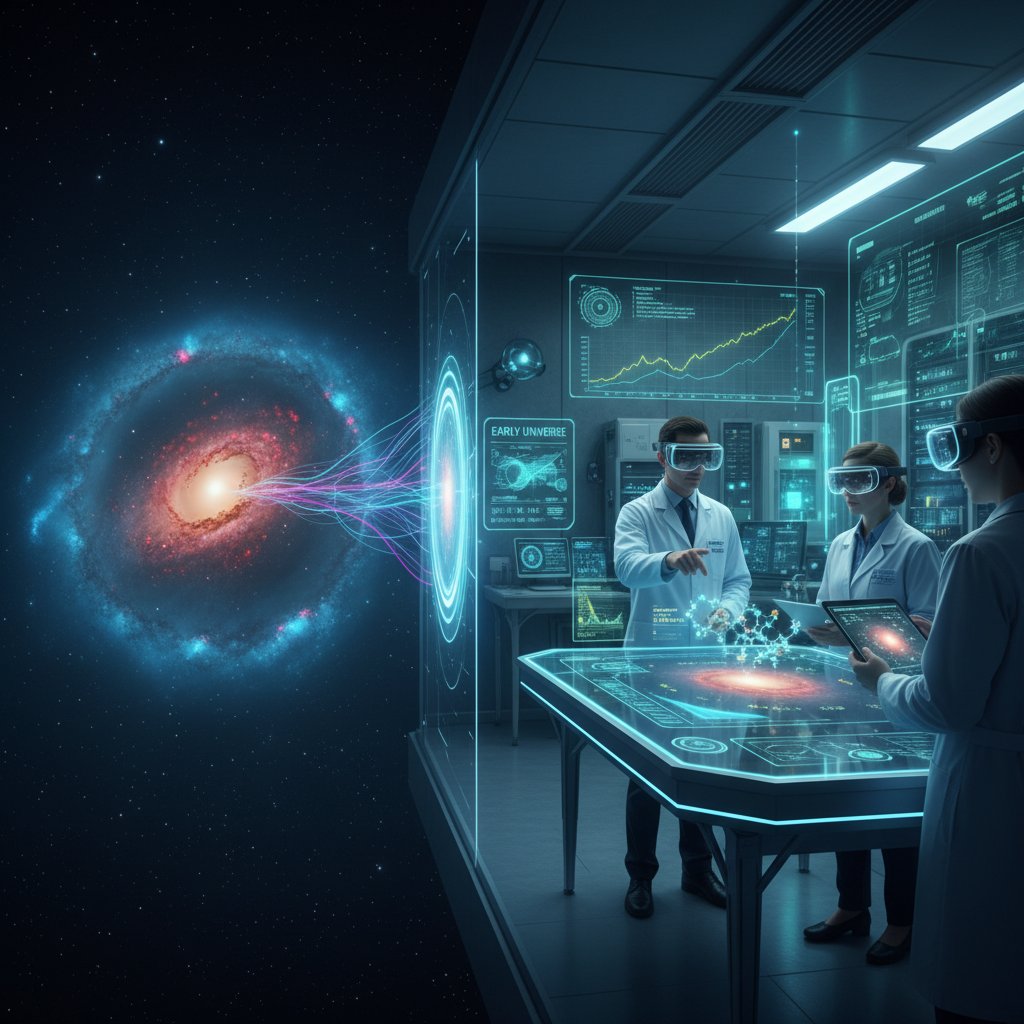
Imagine a galaxy, colossal and brilliant, burning through its star-forming fuel with an almost reckless intensity. Then, suddenly, it stops. No new stars ignite. The galaxy grows quiet, a cosmic ghost drifting through the void. For decades, astronomers have puzzled over these so-called “red and dead” galaxies—massive systems that formed stars rapidly in the early universe only to shut down within a billion years. Now, a team of researchers led by Dr. Emily Chen at the Max Planck Institute for Astrophysics has identified a primary culprit: a violent, galaxy-wide shockwave triggered by the merger of supermassive black holes at the galaxies’ centers.
The study, published this month in Nature Astronomy, combines new observations from the Atacama Large Millimeter/submillimeter Array (ALMA) in Chile with simulations from the IllustrisTNG project. The team focused on three massive galaxies at redshifts between 2 and 3—meaning we see them as they were roughly 10 to 11 billion years ago. These galaxies had already ceased star formation, despite being rich in cold gas, the raw material for new stars. “The gas was there, but something was preventing it from collapsing,” says Dr. Chen. “We needed to find the mechanism.”
Quenching the Cosmic Forge
Galaxies die when they lose the ability to form new stars, a process astronomers call “quenching.” For massive galaxies—those with stellar masses exceeding 100 billion suns—this quenching is particularly abrupt. Previous theories suggested that supernova explosions or radiation from active galactic nuclei could heat or expel the gas. But the new study points to a different, more dramatic event: the merger of two supermassive black holes at the galaxy’s core.
Using ALMA’s high-resolution imaging, the researchers detected vast outflows of ionized carbon gas moving at speeds exceeding 1,000 kilometers per second—far faster than typical galactic winds. These outflows, they argue, are the aftermath of a black hole merger. When two black holes spiral together, they release a burst of gravitational waves. But more critically, they also launch a shockwave that propagates outward through the galaxy, heating and dispersing the cold gas reservoirs. “It’s like a cosmic sledgehammer,” explains Dr. Marcus Rivera, a co-author from the Harvard-Smithsonian Center for Astrophysics. “The shockwave doesn’t just heat the gas; it physically pushes it out of the galaxy, starving it of the fuel needed to form stars.”
“These galaxies were once the most active star-forming factories in the universe. Then, in a cosmic blink, they went dark. We’ve now identified the smoking gun.” — Dr. Emily Chen, Max Planck Institute for Astrophysics
A Timeline of Galactic Death
The findings offer a coherent timeline. In the early universe, massive galaxies formed through rapid mergers of smaller galaxies, each bringing its own supermassive black hole. These black holes would eventually merge, triggering the fatal shockwave. The team’s simulations show that the process unfolds over roughly 100 million years—a brief period in cosmic terms. Within that window, star formation plummets by 90% or more, and the galaxy transitions from a blue, star-forming state to a red, quiescent one.
Dr. Chen’s team cross-referenced their ALMA data with optical and infrared observations from the Hubble Space Telescope and the Keck Observatory. They found that the three target galaxies all showed signs of recent mergers—distorted shapes, tidal tails, and multiple nuclei. “The evidence is consistent,” says Dr. Rivera. “The galaxies that die young are those that experienced a major merger event, and the black hole merger is the final blow.”
This mechanism explains a long-standing puzzle: why some massive galaxies in the early universe have extremely low star formation rates despite abundant gas. It also clarifies why these galaxies are often found in dense clusters, where mergers are more common. “It’s not that the gas is missing,” notes Dr. Chen. “It’s that it’s been thrown into the intergalactic medium, where it can’t form stars.”
Implications for Galaxy Evolution
The study has broader implications for our understanding of how galaxies evolve. In the local universe, massive elliptical galaxies—like M87 in the Virgo Cluster—are known to be “red and dead.” The new research suggests they may have undergone similar black hole merger events billions of years ago. “Every massive galaxy in the modern universe probably went through this phase at some point,” says Dr. Chen. “The difference is timing. Some died young; others took longer.”
The findings also highlight the importance of multi-messenger astronomy. Detecting gravitational waves from black hole mergers—as done by LIGO and Virgo for stellar-mass black holes—could eventually confirm the process for supermassive pairs. Future observatories like the Laser Interferometer Space Antenna (LISA), set to launch in the 2030s, will be sensitive to the lower-frequency gravitational waves emitted by supermassive black hole mergers. “LISA will open a new window,” says Dr. Rivera. “We’ll be able to directly observe the events that kill galaxies.”
What This Means for the Milky Way
Could the Milky Way suffer a similar fate? Our galaxy is currently on a collision course with the Andromeda Galaxy, set to merge in about 4.5 billion years. Both galaxies host supermassive black holes—Sagittarius A* in the Milky Way and a larger counterpart in Andromeda. When they merge, the black holes will likely coalesce, potentially triggering a shockwave. However, Dr. Chen cautions that the outcome depends on the available gas. “The Milky Way and Andromeda are relatively gas-poor compared to the early-universe galaxies we studied. The shockwave might not be as dramatic.” Still, the merger could temporarily disrupt star formation and heat the galactic center.
For now, the study provides a satisfying answer to a cosmic mystery. It also serves as a reminder of the violent processes that shape the universe. “Galaxies are not static,” says Dr. Chen. “They live and die, and we’re only beginning to understand the forces that drive their life cycles.” The next step for her team is to survey a larger sample of quenched galaxies across different cosmic epochs, using the upcoming James Webb Space Telescope and the Nancy Grace Roman Space Telescope. “We want to see if this mechanism is universal,” she concludes. “If it is, we’ve found a key piece of the puzzle of how the universe built its largest structures.”