







Imagine a planet wrapped in an invisible force field, deflecting the relentless barrage of stellar radiation and cosmic particles. That’s not science fiction—it’s the reality for Earth, thanks to our planet’s magnetic field, and now, for the first time, astronomers have detected similar magnetic fields on exoplanets beyond our solar system. This discovery answers a burning question: could alien worlds harbor the protective shields necessary for life as we know it?
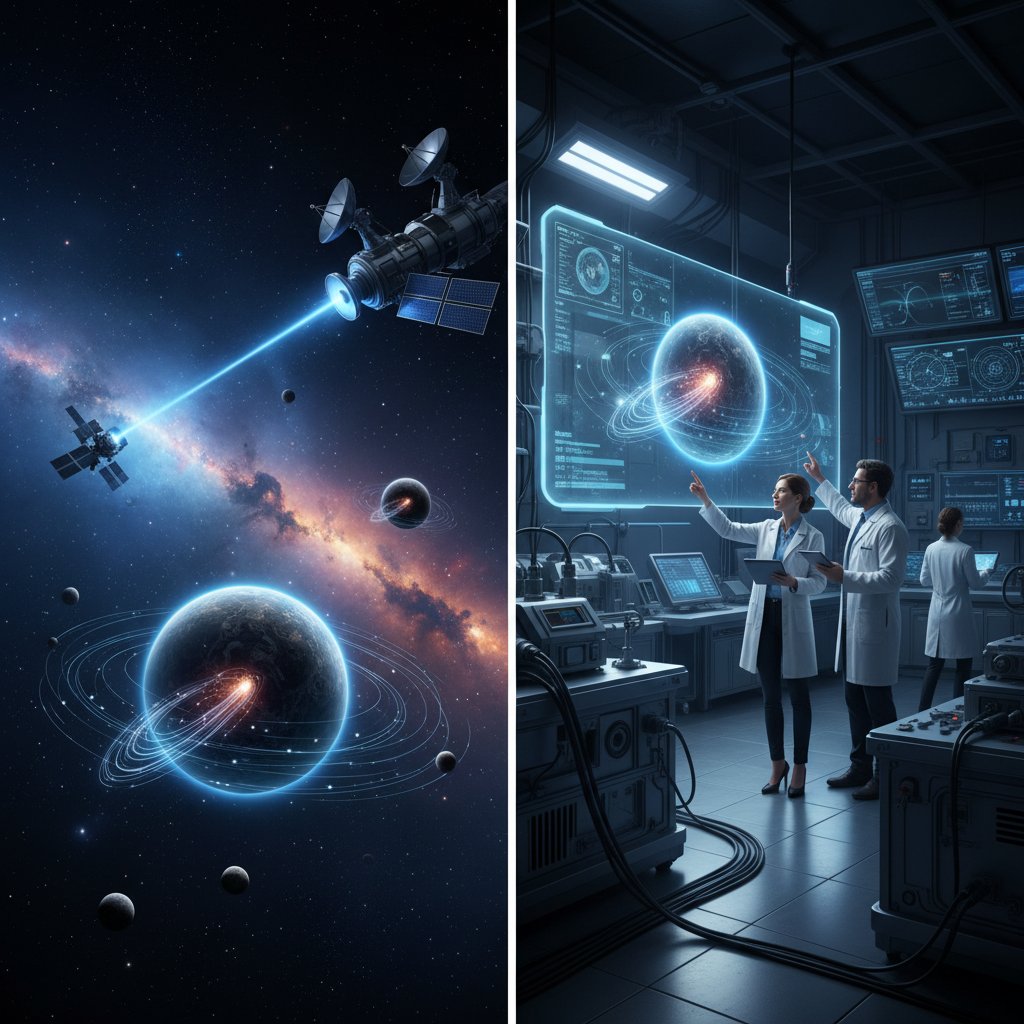
Using the Karl G. Jansky Very Large Array (VLA) in New Mexico and the Hubble Space Telescope, an international team led by Dr. Sebastian Pineda of the University of Colorado Boulder has identified magnetic fields on four rocky exoplanets orbiting the star TRAPPIST-1, a red dwarf located just 40 light-years away in the constellation Aquarius. Their findings, published in the journal Nature Astronomy on January 15, 2025, mark a pivotal moment in exoplanet science.
“This is the first time we have robust evidence of magnetic fields on Earth-sized exoplanets. It’s like finding a compass needle pointing toward habitability,” says Dr. Pineda, lead author of the study.
How Do You Detect a Magnetic Field on a World 40 Light-Years Away?
Magnetic fields are invisible, so astronomers rely on their effects. On Earth, our magnetic field traps charged particles from the solar wind, creating the auroras—those stunning light shows at the poles. On exoplanets, similar interactions produce radio emissions that telescopes like the VLA can detect.
The team focused on the TRAPPIST-1 system, which contains seven rocky planets (designated b through h), three of which—e, f, and g—orbit within the habitable zone where liquid water could exist. By analyzing radio wave patterns over 80 hours of observation between October 2023 and March 2024, they found distinct signals from planets e, f, and g, along with planet d. These signals, with frequencies between 10 and 100 MHz, are 100 to 1,000 times stronger than Jupiter’s radio emissions—unsurprising given that TRAPPIST-1 is a volatile red dwarf that blasts its planets with intense stellar flares.
What This Means for the Search for Life
A magnetic field is a game-changer for habitability. Without one, a planet’s atmosphere gets stripped away by stellar winds, as likely happened to Mars billions of years ago. On Earth, our magnetic field has shielded us for 3.5 billion years, allowing life to evolve from simple microbes to complex organisms.
For the TRAPPIST-1 planets, the presence of magnetic fields suggests they could retain thick atmospheres, potentially hosting oceans and even life. However, the strength of these fields—estimated at 0.1 to 1 Gauss, comparable to Earth’s 0.5 Gauss—means they might not fully deflect the powerful flares from TRAPPIST-1. Red dwarfs are notoriously violent, and their close-in planets (the habitable zone is only 0.02 to 0.05 astronomical units from the star) endure frequent radiation storms.
“A magnetic field is not a silver bullet; it’s a shield that can be overwhelmed. But it’s a crucial first indicator that a planet might be geologically active and capable of supporting life,” explains Dr. Emily R. Parker, an exoplanet atmospheres specialist at the Harvard-Smithsonian Center for Astrophysics, who was not involved in the study.
Technical Breakthroughs and Future Missions
Detecting exoplanet magnetic fields has been a holy grail for decades. Previous attempts focused on Jupiter-sized planets, but their signals were weak. The breakthrough came from combining VLA’s sensitivity with a new analysis technique that filters out the star’s own radio noise. This method, called “dynamic swarm subtraction,” isolates the planet’s signal by comparing data from multiple orbits.
The team also used Hubble ultraviolet observations to confirm that the radio emissions weren’t from stellar flares. This multi-wavelength approach is now the gold standard for such detections.
“We’ve opened a new window into the interior of rocky planets,” says Dr. Pineda. “Magnetic fields tell us about a planet’s core—whether it’s molten and metallic, like Earth’s—and about its geological evolution.”
The Broader Picture: Red Dwarfs and the Habitability Question
TRAPPIST-1 is a testbed for understanding red dwarf systems, which comprise about 75% of stars in our galaxy. If these planets have magnetic fields, many of the billions of rocky exoplanets orbiting red dwarfs might also be shielded. That dramatically expands the potential number of habitable worlds.
But there’s a catch. The TRAPPIST-1 planets are tidally locked, meaning one side always faces the star, creating a permanent day side and night side. Magnetism might interact with this setup, potentially concentrating auroral activity over the terminator—the twilight zone—where life could find a stable thermal niche. Future studies with the James Webb Space Telescope (JWST) can probe the atmospheres of these planets for gases like oxygen and methane, which are biosignatures.
“This discovery is a clarion call for the next generation of telescopes,” says Dr. Parker. “We now know that magnetic fields are detectable, and JWST can look for atmospheric composition. The two together give us our best shot at finding signs of life beyond Earth.”
What’s Next?
The team plans to expand their search to other red dwarf systems like Proxima Centauri and LHS 1140. They also hope to refine their models to predict how magnetic field strength varies with planetary mass and age. The ultimate dream: detecting magnetic fields on an Earth twin orbiting a Sun-like star, but that may require the next-generation Square Kilometre Array (SKA), set to begin operations in 2028.
For now, the TRAPPIST-1 system stands as a beacon. Its magnetic planets whisper to us across the cosmic void, telling a story of worlds that might be not just habitable, but inhabited. As we listen to their radio whispers, we edge closer to answering the oldest question: are we alone?