







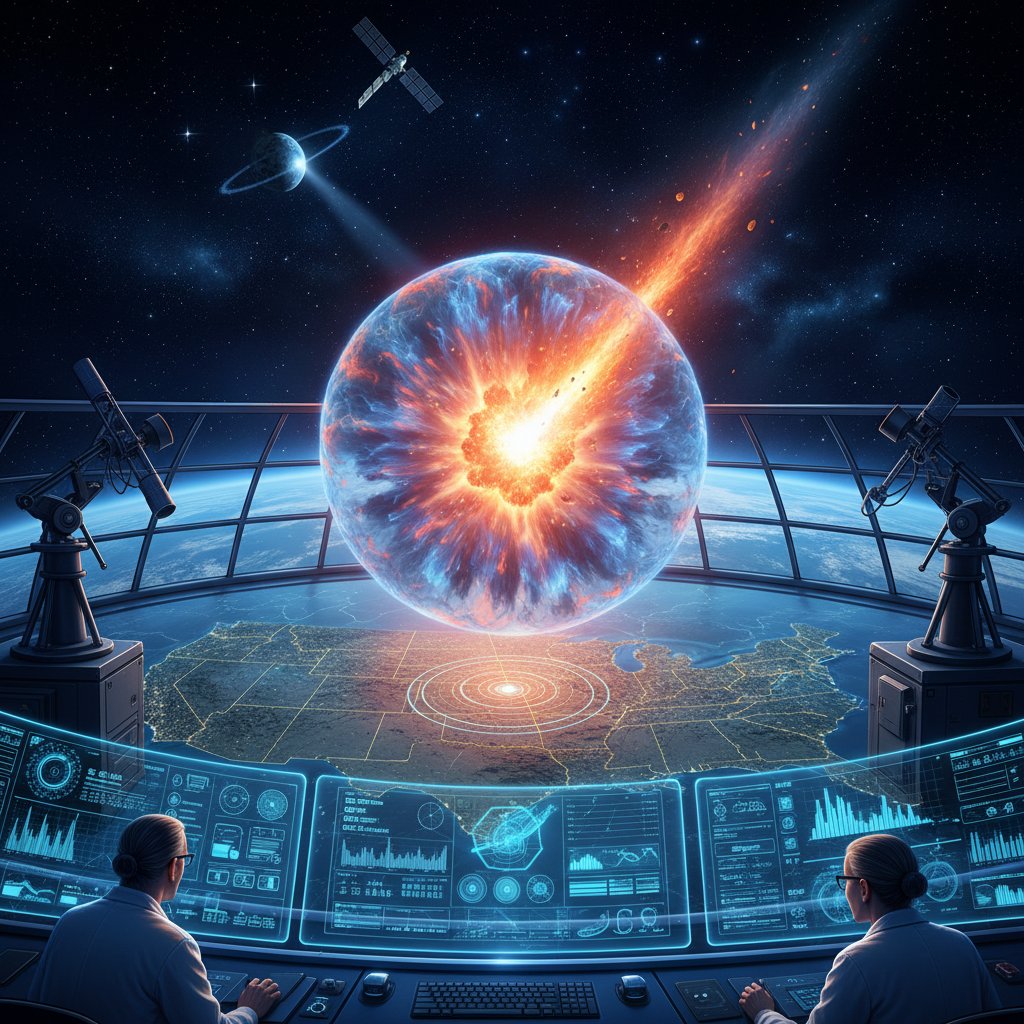
On Tuesday evening, a bright fireball streaked across the sky over the northeastern United States, exploding roughly 35 kilometers above rural Pennsylvania with a force equivalent to 30 tons of TNT. The resulting sonic boom rattled windows and startled residents across Pennsylvania, New Jersey, and New York. No injuries or structural damage have been reported, but the event has reignited public interest in the frequency and hazard of small asteroid impacts.
Meteors entering Earth’s atmosphere at hypervelocity—typically between 11 and 72 kilometers per second—compress air ahead of them, heating up until they disintegrate or explode. This particular object, estimated at 1.5 meters in diameter and weighing roughly 10 tons, was detected by NASA’s Center for Near Earth Object Studies (CNEOS) mere minutes before impact. The explosion, technically an airburst, occurred at an altitude where the atmosphere is dense enough to trigger a shockwave but thin enough that most of the rock vaporized before reaching the ground.
Event Details and Eyewitness Reports
The American Meteor Society (AMS) received over 600 reports from the public within hours of the event. Witnesses described a brilliant blue-white flash followed by a deep, rumbling boom that lasted several seconds. Radar data from the National Weather Service confirmed a signature consistent with a high-altitude explosion. The fireball’s trajectory was captured by multiple all-sky cameras operated by NASA’s Meteoroid Environment Office, which triangulated the debris field over forested land near the town of Snow Shoe, Pennsylvania.
This event is part of a larger pattern. According to NASA data, about 30–50 small meteor airbursts occur over the United States each year. Most go unnoticed because they happen over oceans or remote areas. However, recent improvements in ground-based sensors and public reporting networks mean that even modest events like this one are now widely documented.
Physics of Airbursts: Why Meteors Explode
When a meteor enters the atmosphere at speeds exceeding Mach 50, its kinetic energy rapidly converts into heat. The extreme stress causes the rock to fragment into smaller pieces in a process called catastrophic disruption. A shockwave forms, and when the internal pressure exceeds the strength of the asteroid, it explodes. This mechanical failure is fundamentally different from a chemical explosion—it’s a rapid release of kinetic energy.
Dr. Sarah Thomas, a planetary scientist at the University of Arizona’s Lunar and Planetary Laboratory, explains: “A rock that is 1.5 meters in diameter carries energy comparable to a small nuclear weapon, but that energy gets spread across a large volume of atmosphere. The boom you hear is the sonic boom generated by supersonic fragments and the abrupt expansion of heated air.”
“A rock that is 1.5 meters in diameter carries energy comparable to a small nuclear weapon, but that energy gets spread across a large volume of atmosphere.”
— Dr. Sarah Thomas, University of Arizona
The resulting shockwave weakens with distance, but at ground level, it can still produce overpressures of several hundred pascals—enough to rattle windows and cause minor alarm. Tuesday’s event was comparable in energy to the 2018 airburst over Michigan, which also produced a widely felt sonic boom.
Historical Context and Hazard Assessment
The most famous airburst in recent memory is the 2013 Chelyabinsk event in Russia, where a 20-meter-wide meteor exploded at 30 kilometers altitude, releasing equivalent energy of 500 kilotons of TNT. That blast injured over 1,500 people, mostly from shattered glass. Tuesday’s meteor was substantially smaller—roughly 100 times less energetic—but the acoustic effects were still noticeable over an area of 12,000 square kilometers.
Dr. Mark Robinson, a meteor physicist at NASA’s Marshall Space Flight Center, notes that such events occur on average once per decade over populated regions. “If this meteor had been slightly larger—say, 5 meters in diameter—we’d be dealing with a significant risk to people on the ground. The Chelyabinsk meteor was a wake-up call. We need to continue investing in detection systems that can give us even a few hours’ warning.”
Current detection relies on satellite-based sensors and ground-based radar. The NASA-funded Scout system now provides warnings for objects larger than about 1 meter, but the window is often only minutes. For Tuesday’s event, the object was tracked for roughly 90 minutes before impact, yet it was still too small and fast to warn the public in a meaningful way.
What This Means for You
For the average person, the risk from a meteor airburst is extremely low. However, the psychological impact can be significant. Many residents reported anxiety and confusion as the boom rattled their homes, mistaking it for an earthquake or explosion. Local emergency services were flooded with calls. This highlights a need for rapid public communication; even a short alert—”Fireball detected, sonic boom likely”—could reduce panic.
The event also underscores the importance of citizen science. The AMS fireball report page allows anyone to submit observations, and these data help scientists refine trajectory models and assess potential meteorite falls. In Tuesday’s case, no meteorites have been recovered, but the debris field may yield small fragments in the coming weeks. Amateur meteorite hunters are already heading to the area, but experts caution that private land should not be disturbed without permission.
Looking ahead, NASA’s upcoming NEO Surveyor mission, scheduled for launch in 2028, will dramatically improve the detection of asteroids as small as 10 meters, giving weeks of warning for objects that could cause significant ground damage. For objects smaller than that, current systems remain imperfect. As Dr. Thomas remarks: “The atmosphere is our best shield, but we’re still in the dark about a lot of what’s flying around out there. Every event like this is a reminder that space is not empty.”