







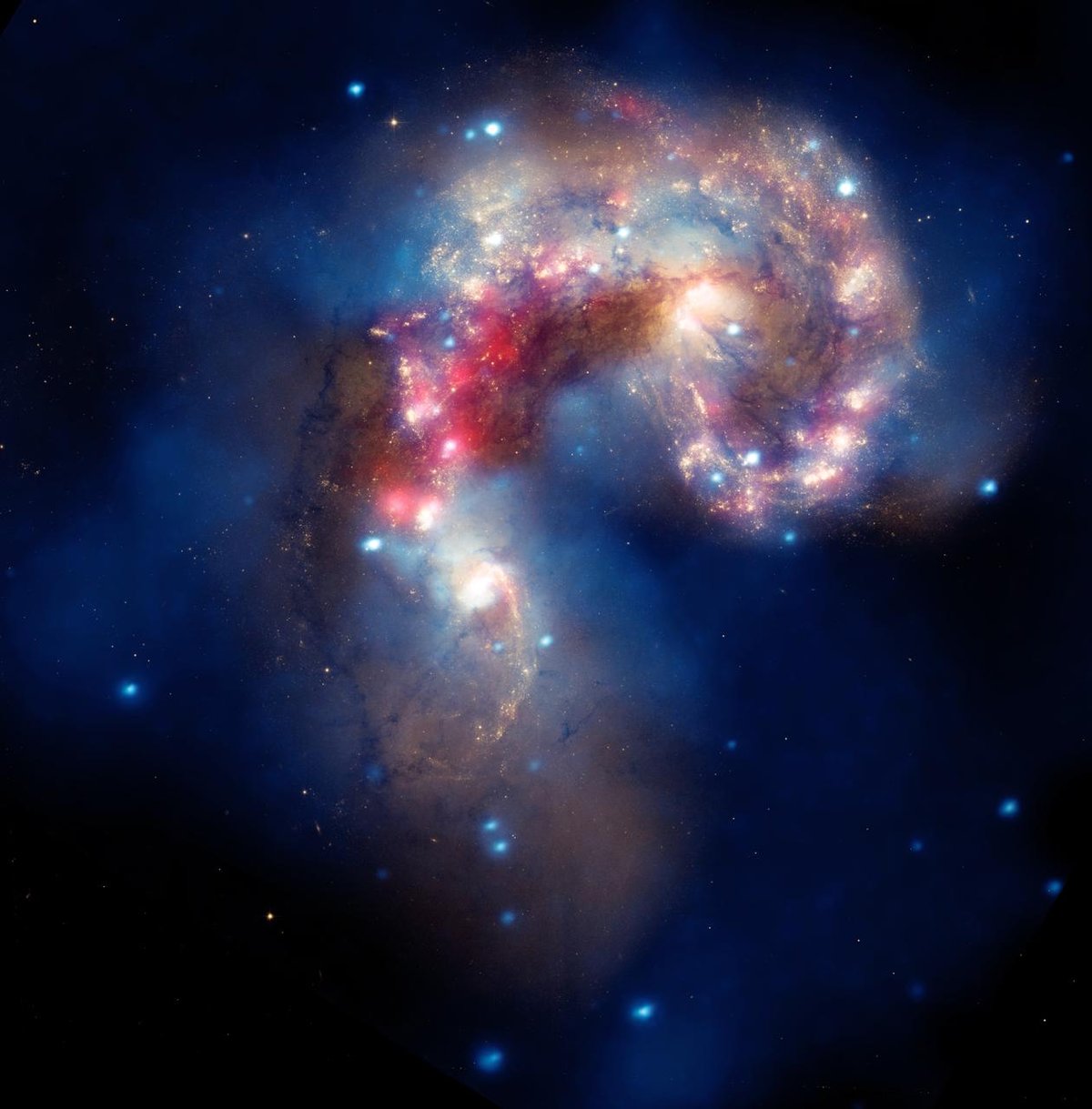
What if the universe threw a birthday party for America and decided to dress up in patriotic colors? That’s exactly what NASA‘s Chandra X-ray Observatory has done — unveiling four cosmic images rendered in red, white, and blue to celebrate the 250th anniversary of the United States. Alongside these visuals, the space agency dropped a trio of new sonifications, letting us hear the universe in a whole new way. It’s science, it’s art, it’s a love letter to exploration. And honestly? It’s stunning.
Let’s be clear: the cosmos doesn’t care about human borders or holidays. But the way we interpret space — that’s deeply human. So when NASA decided to map X-ray data from deep-space objects onto a red-white-blue palette, they weren’t just making pretty pictures. They were building a bridge between raw astrophysics and cultural celebration. The result? A series of images that look like abstract paintings but contain hard data from objects thousands of light-years away.
A Cosmic Fourth of July: Chandra’s Patriotic Palette
The four newly released images showcase some of the most iconic objects in Chandra’s 25-year catalog. Take the Crab Nebula, for instance — a supernova remnant that’s been studied for centuries. In Chandra’s X-ray view, the nebula’s pulsar winds are rendered in shimmering white, with hotter regions glowing red and cooler pockets of gas shining blue. Then there’s Cassiopeia A, the remains of a star that exploded 340 years ago. Its outer blast wave appears as a brilliant white ring, while iron-rich knots glow a deep, almost crimson red.
But the lineup doesn’t stop there. A third image captures the galaxy cluster MS 0735.6+7421 — a behemoth where supermassive black hole jets have carved cavities the size of the Milky Way. In the red-white-blue rendering, the hot intracluster gas takes on a ghostly blue, the jets white, and the surrounding background a faint red. The fourth image shows the supernova remnant G292.0+1.8, a lesser-known but visually spectacular object, where the expanding debris clouds form a near-perfect star-shaped pattern in patriotic hues.
“We wanted to do something fun and creative for the 250th,” says Dr. Kimberly Arcand, Chandra visualization scientist at the Smithsonian Astrophysical Observatory. “But the science is real — every color maps to a specific X-ray energy. Red represents lower energy, white is medium, blue is high. It’s a true spectrum, just reimagined.”
(And yes, this is the same Chandra team that brought us the quiet heroes shaping space exploration — the scientists who’ve spent decades decoding this cosmic light.)
Listening to the Stars: The Art of Sonification
If the images are a visual feast, the sonifications are a whole different course. Sonification is the process of translating astronomical data into sound — not as a gimmick, but as a serious tool for accessibility and discovery. For the US 250th, Chandra released three new sonifications: one for the Crab Nebula, one for Cassiopeia A, and one for the galactic center region.
Each sonification works like this: the X-ray brightness of different regions controls pitch and volume. Brighter spots become higher notes. The Crab Nebula’s pulsar, which rotates 30 times per second, becomes a steady, rhythmic beat — almost like a cosmic metronome. Cassiopeia A, on the other hand, sounds chaotic: sharp, percussive bursts from its outer shock waves, with a deep, droning hum from the expanding iron debris.
The galactic center sonification is perhaps the most eerie. It sweeps across Sagittarius A*, our supermassive black hole, turning the swirling gas into a low, menacing rumble punctuated by high-pitched flurries from nearby stellar flares. “Sonification isn’t just for blind or visually impaired audiences,” says Dr. Arcand. “It reveals patterns our eyes might miss. Sometimes your ears hear what your brain can’t see.”
This isn’t the first time Chandra has done sonification — they’ve been at it since 2020. But the 250th edition feels different. It’s celebratory. It’s experimental. And it’s a reminder that our cosmic neighborhood keeps surprising us, whether through impact hazards or hidden symphonies.
Why This Matters: Science, Art, and National Pride
Now, you might be thinking: Isn’t this a bit frivolous? Spending public money on themed space images? Fair question. But here’s the thing — NASA’s budget for public engagement is a fraction of a percent of overall agency spending. And the return on investment? Immeasurable. These images and sounds get people excited. They get kids asking questions. They make the abstract tangible.
The United States turns 250 in 2026, and NASA has been planning celebrations across all its missions. Chandra, which launched in 1999, is one of the agency’s longest-lived observatories. It’s also uniquely suited for this: X-ray astronomy reveals the most violent, energetic processes in the universe — supernovae, black hole jets, galaxy mergers. By mapping these onto a patriotic palette, NASA is saying: This is what American ingenuity has unlocked. We’ve been exploring the unknown for two and a half centuries, and we’re not stopping now.
Dr. Paul Plucinsky, Chandra mission scientist at Harvard-Smithsonian Center for Astrophysics, puts it this way: “Chandra has fundamentally changed our understanding of the high-energy universe. Every time we release new images — even themed ones — we’re sharing discoveries that rewrite textbooks. The red-white-blue coloring is just the icing on a very data-rich cake.”
And it’s not just for Americans. The images are freely available online. Anyone on Earth can download them, print them, or use them in classrooms. That’s the whole point — space belongs to everyone.
What’s Next for Chandra?
Chandra is aging. It’s now 25 years old, well past its original 5-year design life. But it’s still going strong — albeit with some operational tweaks. In recent years, the team has had to manage thermal constraints and adjust orbits. Still, the observatory remains in high demand. Scientists around the world compete for observing time, and each year Chandra produces landmark studies — from measuring dark energy to mapping the first X-ray images of exoplanet atmospheres.
But the clock is ticking. NASA has not committed funding beyond the current decade. A senior review in 2025 will determine whether Chandra gets a reprieve or faces a gradual shutdown. (There’s a fascinating group of NASA scientists quietly shaping the future who are already working on next-generation X-ray observatories like Lynx, but that’s still a concept.)
For now, though, the red-white-blue images are a celebration of durability. They’re a reminder that the universe — and America’s ability to explore it — has a long runway ahead. So go ahead: download the images. Crank up the sonifications. Look at the Crab Nebula and think: that light left its source 6,500 years ago, right around the time humans first started building cities. And now we’re turning it into a song. Happy birthday, America.
Frequently Asked Questions
What is the Chandra X-ray Observatory?
Chandra is one of NASA’s four Great Observatories, launched in 1999. It detects X-ray emission from extremely hot regions of the universe, such as exploded stars, black holes, and galaxy clusters. Its data has revolutionized our understanding of high-energy astrophysics.
How does sonification work in astronomy?
Sonification translates digital data (like pixel brightness or spectral energy) into sound. For Chandra’s images, different X-ray energy levels are mapped to different pitches and volumes. This makes the data accessible to blind/visually impaired audiences and can sometimes reveal subtle patterns not obvious in visual analysis.
Why are the images colored red, white, and blue?
The colors are chosen to celebrate the 250th anniversary of the United States. But each color corresponds to a real physical property: red for lower-energy X-rays, white for medium, and blue for high-energy X-rays. The artistic palette does not distort the scientific meaning — it’s a creative remapping of existing data.