







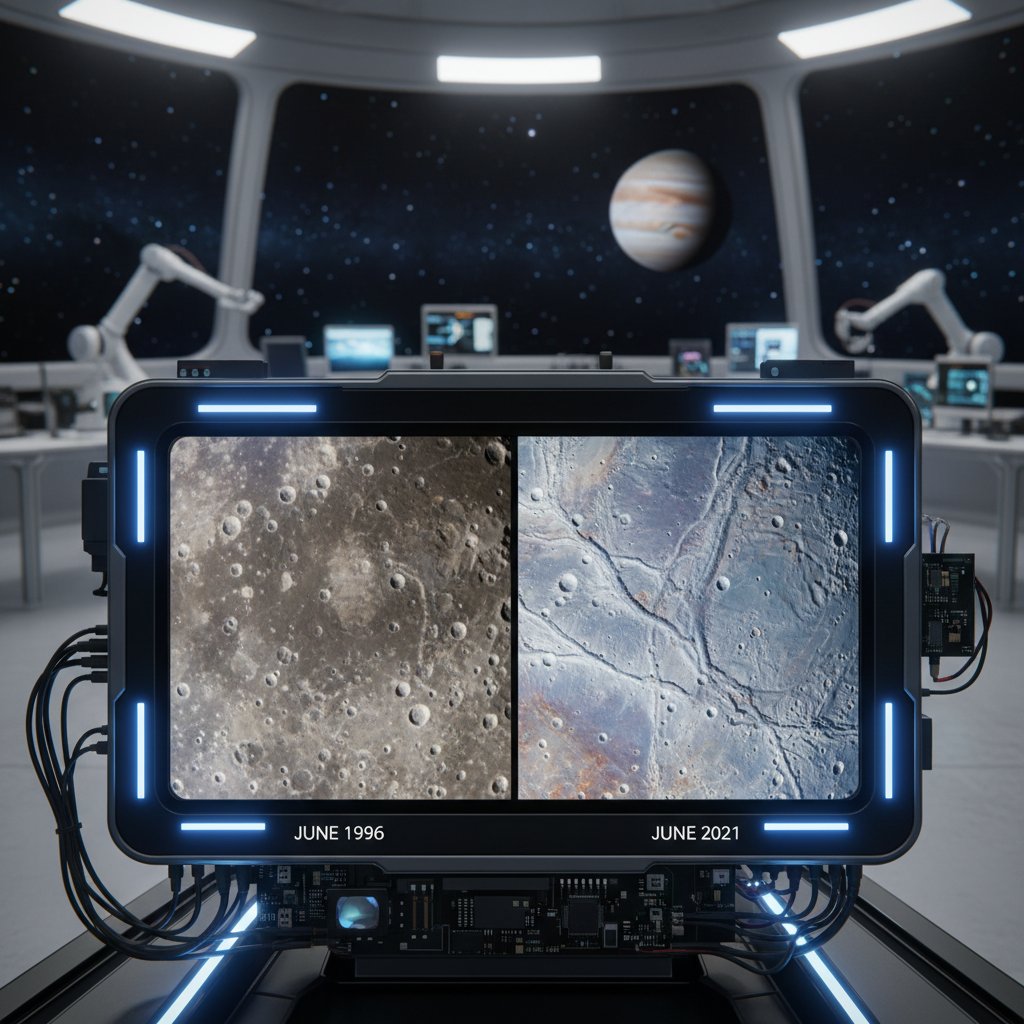
Nobody is talking about this, but comparing two images of Ganymede taken 25 years apart reveals something profound about our solar system. In June 1996, NASA‘s Galileo spacecraft performed humanity’s first-ever close flyby of Jupiter’s icy moon Ganymede. Nearly a quarter-century later, in June 2021, Juno made the next closest approach, skimming just 1,038 kilometers above its surface. The two flybys — separated by a generation of technology — are like a before-and-after portrait of a world that refuses to stay still.
And what a world it is. Ganymede is the largest moon in the solar system, bigger than the planet Mercury. It’s the only moon known to generate its own magnetic field, and scientists suspect it harbors a salty subsurface ocean buried beneath an ice crust 150 kilometers thick. But until Galileo arrived, Ganymede was little more than a yellowish dot in the sky. Galileo changed that — and Juno has now rewritten the textbook.
The First Close-Look: Galileo’s 1996 Flyby
Galileo reached Jupiter in 1995 after a six-year journey. Its camera, a 1980s design with a resolution comparable to early digital cameras, captured the first detailed views of Ganymede’s grooved terrain and dark, cratered regions. During its first flyby on June 27, 1996, Galileo passed 835 kilometers above the surface. The images revealed a complex surface cut by parallel ridges and troughs — a sign of tectonic activity. But the flyby also raised more questions than it answered. Why was the terrain so bright in some areas and dark in others? And where did the magnetic field come from?
“Galileo gave us the first real map of Ganymede, but we saw only pieces of the puzzle,” says Dr. Elizabeth Turtle, a planetary scientist at the Johns Hopkins Applied Physics Laboratory who worked on both Galileo and Juno data. “We knew there was an ocean underneath, but we didn’t know how it interacted with the surface — or how the magnetic field was generated.”
Juno’s 2021 Encounter: A High-Definition Sequel
Fast-forward to June 7, 2021. NASA’s Juno spacecraft, which entered orbit around Jupiter in 2016, executed a precisely timed flyby of Ganymede — the closest any spacecraft had come since Galileo. Juno’s instruments are light-years ahead: its JunoCam captures visible-light images at a resolution of about 1 kilometer per pixel, and its microwave radiometer can peer through the ice to map the subsurface structure. The flyby lasted only a few hours, but the data changed how scientists see the moon.
Among the most striking findings: Ganymede’s polar regions are far more eroded than expected. According to NASA, the flyby showed that the moon’s magnetic field interacts directly with Jupiter’s own giant magnetic field, generating intense auroral zones — glowing curtains of ultraviolet light at the poles. Juno also spotted “ghost” craters: ancient impacts nearly buried by later resurfacing. And it detected complex organic compounds — potential building blocks for life — in the ice.
“The comparison is just breathtaking,” says Dr. Scott Bolton, Juno principal investigator at the Southwest Research Institute. “In 25 years, we went from black-and-white snapshots to a full-color, three-dimensional portrait of a world that is more dynamic than anyone imagined.”
And speaking of records — just as two humpback whales smashed migration records recently, these two flybys are smashing long-held assumptions about how icy moons evolve over time. The changes on Ganymede’s surface between 1996 and 2021 are subtle but real — new fractures, shifting ice patterns, and possible cryovolcanic activity that scientists are still debating.
Why This Matters for the Search for Life
Ganymede isn’t just a frozen ball of rock and ice. It’s a potential habitat for extraterrestrial life. The subsurface ocean is thought to be in contact with a rocky seafloor — a recipe for chemical reactions that could fuel life. Both Galileo and Juno found evidence of salts and brines on the surface, likely brought up from below by upwelling currents. The 2021 flyby also detected signs of hydrated minerals, suggesting that water occasionally erupts through the crust.
The results are feeding directly into planning for the European Space Agency’s JUICE mission (JUpiter ICy moons Explorer), launched in April 2023. JUICE will arrive at Jupiter in 2031 and perform multiple flybys of Ganymede before eventually entering orbit around it. ESA’s JUICE mission will carry a payload of cameras, spectrometers, and radar to map the moon’s ocean in unprecedented detail.
“We now have a baseline to measure change,” says Dr. Olivier Grasset, JUICE project scientist at the University of Nantes. “The 1996 and 2021 flybys are like archaeological layers in time. When JUICE arrives, we’ll be able to see how this world has evolved over three decades.”
What’s Next: The Race to Icy Moons
Ganymede is one of three ocean moons in the Jupiter system — along with Europa and Callisto — and each is a target for future exploration. NASA’s Europa Clipper, set to launch in 2024, will study Europa’s own ocean and crust. But Ganymede remains the heavyweight champion: its ocean is trapped under a thicker, more stable ice shell, possibly preserving ancient evidence longer.
The 25-year gap between Galileo and Juno isn’t just a neat milestone. It’s a testament to how far our technology — and our understanding — has come. We’ve gone from fuzzy images to near-real-time video of a moon 628 million kilometers away. But there’s a sobering thought: Ganymede changes on human timescales. The fractures and frosts we see today might look completely different a century from now. We are watching a living planet, not a frozen relic.
So, what will the next close-up reveal? JUICE will get there in 2031. And if the past 25 years are any guide, it will be a world we’ve never seen before.
Frequently Asked Questions
Why is Ganymede important?
Ganymede is the largest moon in the solar system, bigger than Mercury. It has its own magnetic field, a deep subsurface ocean, and a complex icy surface. Studying it helps scientists understand planetary evolution, ocean worlds, and the potential for life beyond Earth.
What did the 2021 Juno flyby discover that Galileo missed?
Juno’s advanced instruments revealed Ganymede’s polar auroral zones in detail, detected organic compounds on the surface, mapped subsurface structures with microwave radiometry, and showed how Jupiter’s magnetic field reshapes Ganymede’s own field. Galileo’s lower resolution only hinted at these features.
What future missions will study Ganymede?
ESA’s JUICE mission (launched 2023) will arrive at Jupiter in 2031 and perform multiple Ganymede flybys, eventually entering orbit around the moon. NASA’s Europa Clipper (target launch 2024) will also fly by Ganymede on its way to study Europa. Together, these missions will map the ocean, study surface geology, and search for habitability.