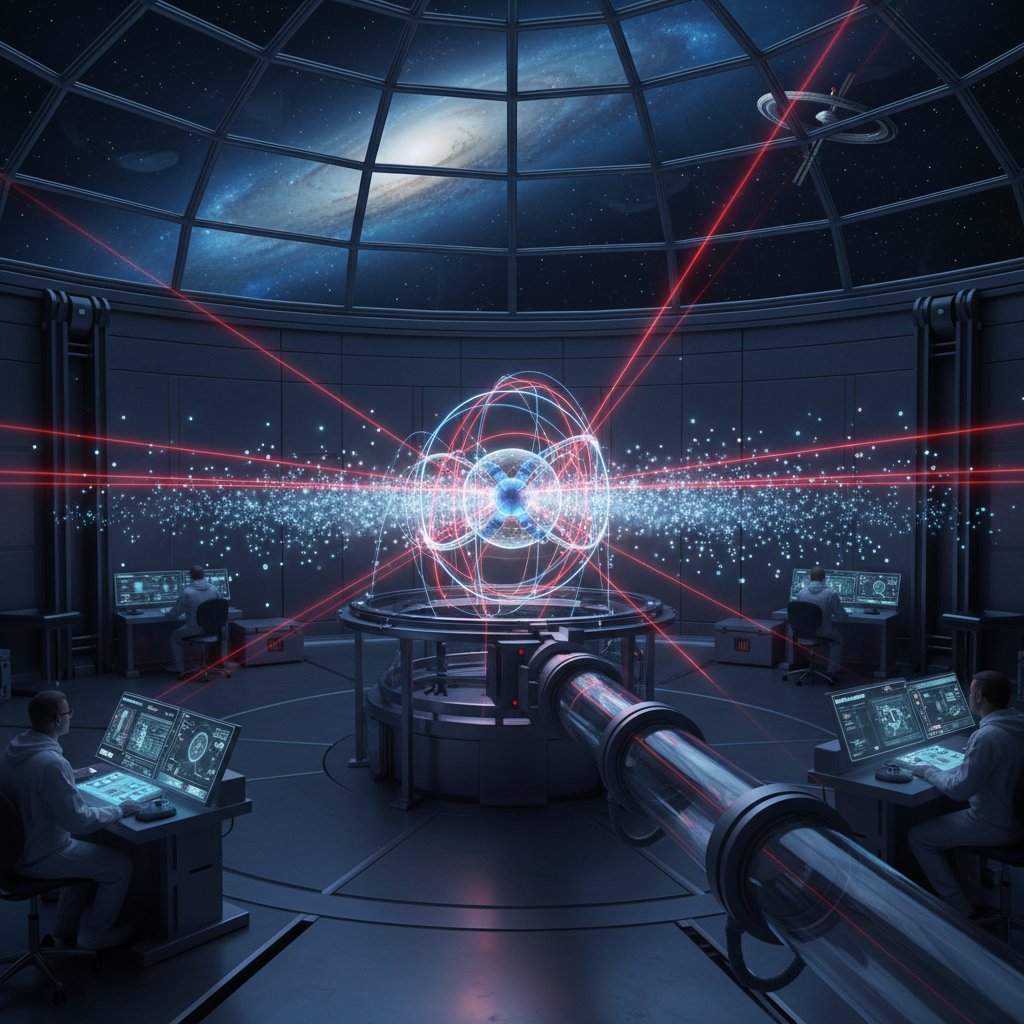








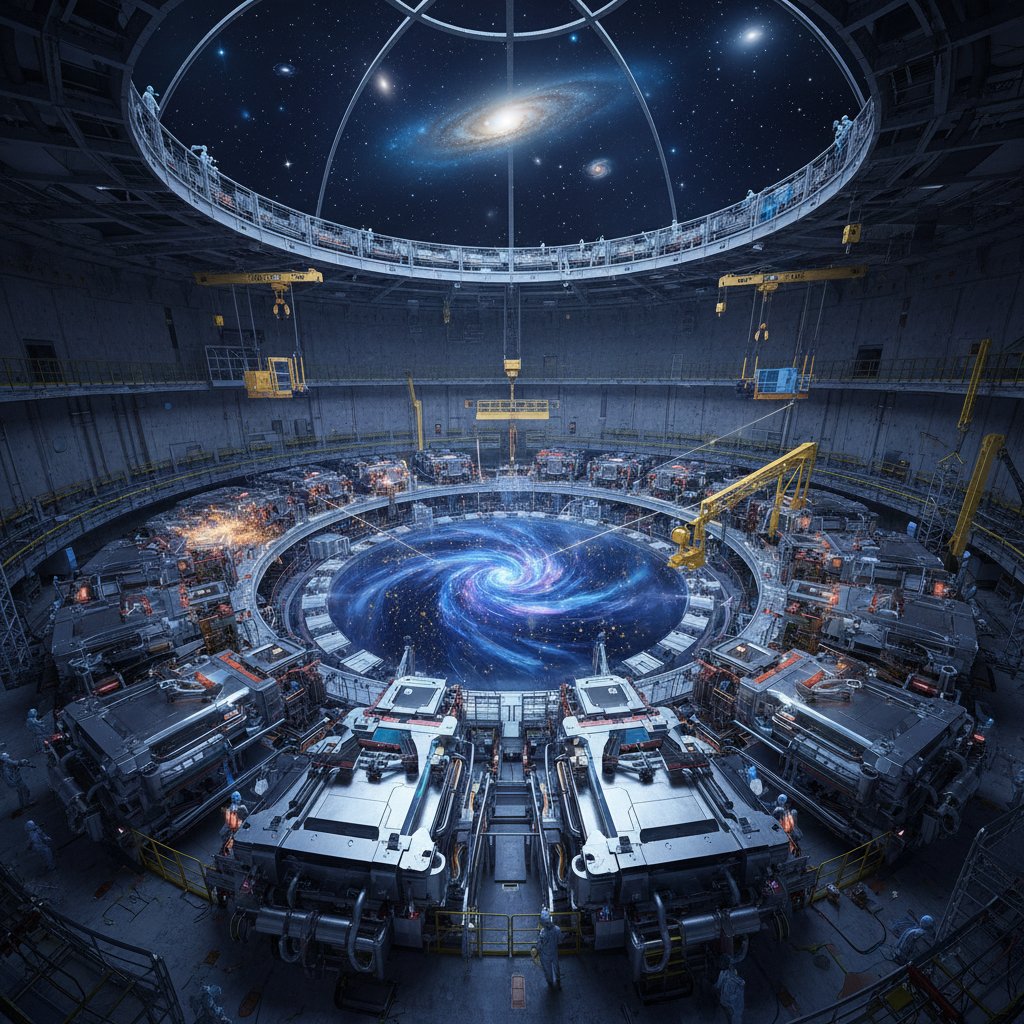
…and it’s not just a routine pit stop. The Large Hadron Collider (LHC), the most powerful particle accelerator ever built, is about to go dark for four years. Starting Monday, the 27-kilometer ring buried beneath the Franco-Swiss border will shut down for a major upgrade—one that physicists hope will finally crack open the case of dark matter, the invisible substance that makes up 85% of the universe’s mass. We know it’s there. We just can’t see it. And after a decade of collisions that gave us the Higgs boson but not a single dark particle, the LHC needs a serious power boost.
Think of it like this: if the LHC were a microscope, it’s been looking at the same slide for years. Now engineers are swapping out the lens for one that’s a hundred times sharper. The upgrade, called the High-Luminosity LHC (HL-LHC), will increase the collision rate by a factor of five to seven. More collisions mean more data. And more data means a better shot at spotting something that’s been hiding in plain sight.
Why Stop Now? The LHC’s Greatest Hits (and Misses)
The LHC first fired up in 2008, smashing protons together at energies never before achieved. In 2012, it delivered the Higgs boson—the particle that gives other particles mass—earning its operators a Nobel Prize. But since then, the machine has been running at near its design limits, producing hundreds of millions of collisions per second. Yet no sign of dark matter. No supersymmetric particles. No extra dimensions.
“We’ve been running the LHC at full throttle for over a decade,” says Dr. Elena Rossi, a particle physicist at CERN and lead coordinator for the upgrade. “We’ve seen everything the Standard Model predicted—and then some. But dark matter remains stubbornly out of reach. To find it, we need to go beyond the Standard Model, and that means we need more collisions than we ever thought possible.”
Indeed, the Standard Model of particle physics—the best theory we have—accounts for only about 5% of the universe. The rest is dark matter and dark energy. The LHC’s job is to create particles from pure energy, and if dark matter particles exist, they should occasionally pop out of collisions. But they’re rare, and they don’t interact with ordinary matter (that’s why they’re dark). So you need to generate an enormous number of collisions to have any hope of producing one.
The current LHC has already produced over 100 inverse femtobarns of data (a unit of collision intensity). The HL-LHC aims for 3,000. That’s like going from a few snapshots to a full-length movie in high definition.
What’s Actually Changing? Magnets, Magnets, Magnets
The heart of the upgrade is a new generation of superconducting magnets. The LHC uses thousands of magnets to steer proton beams around its ring. To increase luminosity (the number of collisions per second), the beams need to be squeezed tighter. That requires stronger, more precise magnets.
“We’re installing about 130 new quadrupole magnets, each weighing over 30 tons, that can produce magnetic fields of 11.5 tesla,” explains Dr. Rossi. “That’s nearly twice the strength of the current magnets. These are the most powerful accelerator magnets ever built.”
But stronger magnets mean more heat. The magnets operate at 1.9 Kelvin—just above absolute zero—cooled by liquid helium. Any upgrade requires dismantling huge sections of the accelerator to replace the magnets and the cryogenic systems. That’s why the shutdown lasts four years. It’s not just a software update; it’s open-heart surgery on a 27-kilometer machine.
The shutdown also includes upgrades to the detectors—ATLAS, CMS, ALICE, and LHCb—which will need to handle the higher collision rates without melting. New tracking systems, faster electronics, and tougher radiation shielding are all part of the package.
Just as two humpback whales smashed migration records by pushing their bodies to the limit, the LHC is about to push its own limits. But unlike the whales, this machine is built to break records—and maybe, a few theories along the way.
Dark Matter: The Elusive Prey
So what exactly are physicists hoping to find? Dark matter isn’t one thing; it’s a category. The leading candidate is the Weakly Interacting Massive Particle (WIMP), a hypothetical particle that interacts via gravity and the weak nuclear force. The LHC has already ruled out WIMPs with masses below about 1 TeV (a trillion electronvolts). The HL-LHC will probe masses up to several TeV.
But there are other possibilities: axions, sterile neutrinos, even particles that interact only gravitationally. The upgrade also increases the chance of spotting new particles that could explain dark matter indirectly, like supersymmetric partners (although SUSY is starting to look less likely).
“The LHC is like a fishing net,” says Prof. James Miller, a theoretical physicist at the University of Zurich who studies dark matter. “We’ve been dragging it through the ocean of particle physics and catching the big fish—like the Higgs. But dark matter might be a tiny, transparent shrimp. To catch it, we need a finer net and we need to drag it through a lot more water. That’s exactly what the HL-LHC will provide.”
But there’s no guarantee. Dark matter might be so weakly interacting that even the HL-LHC can’t produce it. Or it might be much heavier than the LHC can reach. That’s why physicists are also looking for dark matter in other ways—deep underground detectors, space telescopes, and even the engineering marvels of the CITIC Tower (though that one’s just a skyscraper, not a detector).
What Happens During the Shutdown? A Global Effort
While the LHC sleeps, thousands of scientists and engineers will be working around the clock. The magnets are being manufactured in factories across Europe, Japan, and the US. The detectors are being rebuilt in clean rooms. The cryogenic system is being overhauled. It’s a massive coordinated effort that involves over 40 countries.
The shutdown also means a pause in data collection. For the hundreds of physicists who analyze LHC data, it’s a chance to dig through existing data and finish analyses. Some may move to other projects, like neutrino experiments or dark matter direct detection searches. But the mood at CERN is one of anticipation, not frustration.
“We’ve been planning this for a decade,” says Dr. Rossi. “Sure, we’d love to keep running, but you can’t just patch up a machine this complex. You have to stop, upgrade, and come back stronger. That’s how science progresses.”
The restart is scheduled for 2029. When the LHC turns back on, it will immediately begin producing collisions at 14 TeV center-of-mass energy—the same as before—but with far more collisions per second. The first data from the HL-LHC could start flowing in 2030. And if dark matter is within reach, we might know within a few years after that.
But what if we find nothing? That would be a result too. “A null result is not a failure,” Prof. Miller points out. “It tells us where dark matter is not hiding. It forces us to refine our models. And sometimes, the most exciting discoveries come when you least expect them—just like the ballista spider’s trap is perfectly designed to catch ants, but who knew spiders could be that clever? Nature always surprises us.”
For now, the LHC falls silent. The last protons will circulate Monday morning. Then the beams will be dumped, and the long, quiet renovation begins. When it wakes up in 2029, it will be a new machine—one that might finally reveal what the universe is mostly made of. Or it might open doors we didn’t even know existed. Either way, it’s a story worth watching.
Frequently Asked Questions
Q: Why does the LHC need to shut down for four years? Can’t they upgrade it while running?
A: No. The upgrade involves replacing major components, including superconducting magnets, cryogenic systems, and entire detector subsystems. These parts are inside the accelerator tunnel, which must be opened and cooled down. The process requires careful installation, testing, and recommissioning. Four years is actually an aggressive timeline for such a complex overhaul.
Q: What is dark matter, and why is it so hard to find?
A: Dark matter is a form of matter that does not emit, absorb, or reflect light, making it invisible to telescopes. Its existence is inferred from gravitational effects on galaxies and cosmic structures. It’s hard to find because it interacts very weakly with ordinary matter. Particle accelerators like the LHC try to create dark matter particles from high-energy collisions, but they are rare and difficult to detect.
Q: Will the HL-LHC definitely discover dark matter?
A: No, there’s no guarantee. The HL-LHC will explore a wider range of particle masses and interaction strengths than ever before. It has a good chance of finding WIMP dark matter if it exists within the accessible energy range. But dark matter could be much heavier, lighter, or interact through forces we haven’t considered. Even if it finds nothing, the data will constrain theoretical models and guide future experiments.