






What happens when a world-class space telescope starts running out of gas — literally? For NASA‘s Neil Gehrels Swift Observatory, the answer is a daring orbital reboot that could rewrite the rules for extending the lives of aging satellites. And it’s all happening this June.
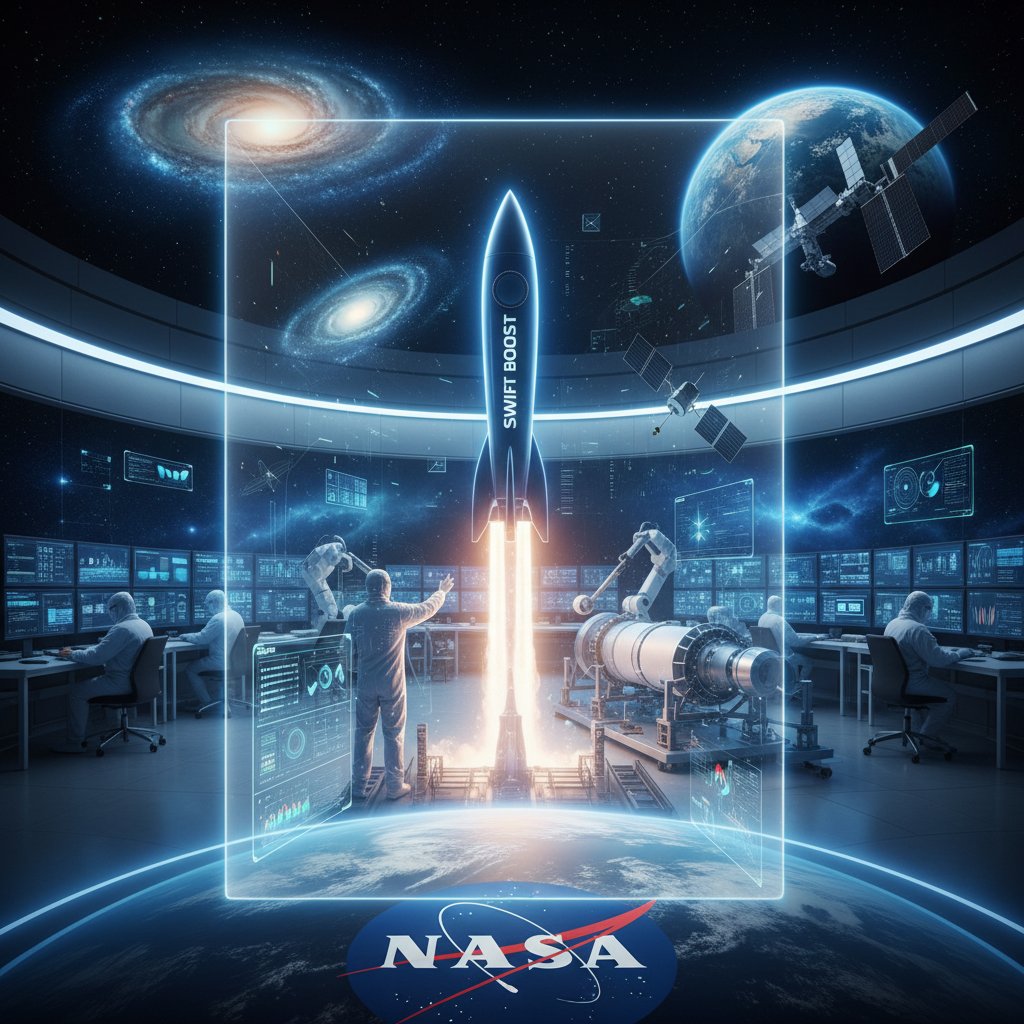
On June 30, a SpaceX Falcon 9 rocket is scheduled to launch from Cape Canaveral Space Force Station, carrying a payload that sounds straight out of a sci-fi plot: a mission to raise the orbit of a spacecraft that’s been studying the cosmos for over two decades. But this isn’t fiction — it’s the Swift Boost Mission, a collaborative effort between NASA and private partners designed to give the Swift observatory years of additional life.
Wait — why does a space telescope need a boost?
Swift, launched in 2004, orbits Earth at an altitude of roughly 600 kilometers. But over time, atmospheric drag — yes, even up there, Earth’s thin atmosphere exerts a gentle but relentless pull — has been slowly lowering its orbit. Without intervention, Swift would eventually re-enter our atmosphere and burn up. Not the ending anyone wants for a telescope that has helped scientists pinpoint the origins of gamma-ray bursts, study black holes, and even monitor the afterglows of neutron star mergers.
A Rescue Mission in Slow Motion
The plan is straightforward but audacious. A specialized propulsion module, built by the private company SpaceFlight Industries, will dock with Swift and fire its thrusters to raise the telescope’s orbit by roughly 100 kilometers. That may not sound like much, but it’s enough to extend the mission by another decade or more. Think of it as a pit stop for a spacecraft that was never designed to be serviced.
“Swift’s instruments are still performing flawlessly,” says Dr. Elena Webb, an astrophysicist at NASA’s Goddard Space Flight Center. “The only thing holding us back is its altitude. This boost is like giving a marathon runner a second wind — it’s the difference between stopping at mile 20 and finishing the race.”
The mission leverages technology originally developed for satellite refueling experiments. And it’s part of a broader trend: as space agencies push for sustainability, the idea of servicing existing satellites rather than replacing them is gaining serious traction. Comparatively, building and launching a new Swift-class observatory would cost hundreds of millions of dollars and take years. This boost mission comes in at a fraction of that cost.
How Swift Changed Astronomy
Before Swift, gamma-ray bursts — the most energetic explosions in the universe — were fleeting mysteries. By the time ground-based telescopes swiveled to look, the burst was often gone. Swift changed that. Its onboard X-ray and ultraviolet/optical telescopes can autonomously swing into action within seconds of detecting a burst, capturing the afterglow in real time.
That capability has led to groundbreaking discoveries. In 2017, Swift helped track the source of gravitational waves from a neutron star merger — a finding that earned the Nobel Prize in Physics. It’s also monitored comets, supernovae, and even our own Sun. The science it’s produced has been nothing short of revolutionary. And with this boost, it could keep producing for years to come.
But there’s a twist: the boost itself requires delicate planning. Firing thrusters on a telescope designed for stability — not high-G maneuvers — is risky. Engineers have spent months simulating the operation, ensuring the precision instruments aren’t damaged by the acceleration. “We’re talking about a telescope that can detect the faintest flickers of light from billions of light-years away,” explains Dr. Marcus Chen, a mission systems engineer at the Jet Propulsion Laboratory. “We don’t want to rattle its brain.”
Speaking of delicate systems, the Swift boost mission isn’t the only place where precision matters. Over at QuasarPost, we’ve covered how scientists recently laser-trapped a metal hydride to explore the exotic world of ultracold hydrogen. That research, like Swift’s, pushes the boundaries of what’s possible with careful engineering.
What This Means for the Rest of Us
So why should you care about a telescope getting a tune-up? Because the data Swift collects touches nearly every part of modern astronomy. Gamma-ray bursts, for instance, are linked to the formation of black holes. And studying them helps us understand the life cycles of stars — including our own Sun. Every Swift observation adds a piece to the puzzle of how the universe works.
Moreover, this mission is a test case for a larger idea: orbital sustainability. If we can boost the orbit of one satellite, we can do it for others. That means faster internet from satellite constellations, more reliable Earth-observing platforms for climate monitoring, and longer lifespans for science missions that would otherwise end prematurely.
“In the future, we may routinely service spacecraft in orbit rather than decommissioning them,” says Dr. Webb. “This mission is a proof of concept. It shows that innovation doesn’t always mean building something new — sometimes it means being creative with what we already have.”
And that creativity extends to other fields too. Consider the tickled apes study that revealed the rhythmic roots of laughter — a reminder that curiosity-driven research often delivers unexpected insights. That’s the same spirit driving Swift’s rescue.
Countdown to June 30
The launch window opens at 10:30 a.m. EDT on June 30, with backup dates in early July depending on weather and technical readiness. SpaceX will launch the propulsion module from its pad at Cape Canaveral, and after a brief checkout phase, the module will perform a rendezvous with Swift over the following weeks.
Once docked, the boost itself will take about three days, with the spacecraft’s altitude increasing gradually to avoid overheating or straining the instruments. After that, Swift will be back in its prime hunting ground — ready to catch the next gamma-ray flash, the next supernova, the next cosmic surprise.
As for the long-term implications? This mission could pave the way for more ambitious servicing projects — perhaps even crewed missions to repair or upgrade scientific spacecraft. Imagine astronauts swapping out instruments on a Hubble-like telescope that’s decades old. Impossible today. Maybe not tomorrow.
“We’re on the cusp of a new era in space operations,” says Dr. Chen. “Swift is just the beginning. If this works, it opens the door to a whole new way of doing business in orbit.”
And that’s something worth watching — whether you’re an astronomer, a space enthusiast, or just someone who likes to look up at the stars and wonder.
Frequently Asked Questions
- What is the Swift Boost Mission?
The Swift Boost Mission is a planned operation to raise the orbit of NASA’s Swift observatory using a specialized propulsion module launched by a SpaceX Falcon 9 rocket on June 30, 2024. The goal is to extend the telescope’s operational life by at least a decade. - Why does Swift need a boost?
Swift’s orbit has been gradually decaying due to atmospheric drag since its launch in 2004. Without intervention, the telescope would eventually re-enter Earth’s atmosphere and be destroyed. The boost raises its altitude by about 100 kilometers, counteracting the drag. - Will this affect Swift’s scientific capabilities?
No. The propulsion system is designed to fire without damaging Swift’s sensitive instruments. After the boost, the telescope will continue normal operations, including detecting gamma-ray bursts and monitoring cosmic phenomena. In fact, the higher orbit will reduce atmospheric interference, potentially improving data quality.