







Think about the last time you really laughed — not a polite chuckle, but a full belly laugh that left you gasping. Now imagine your great ape cousin, a chimpanzee or gorilla, doing the same thing during a tickle session. It turns out, that sound isn’t so different from your own. A groundbreaking study published this week in the journal Current Biology has shown that laughter’s rhythmic structure — its unique, panting pulse — is shared across all great apes, including human children. This isn’t just a fun fact for zoos. It rewrites what we know about how laughter evolved, and it hints that our capacity for play and social bonding runs deeper than we ever imagined.
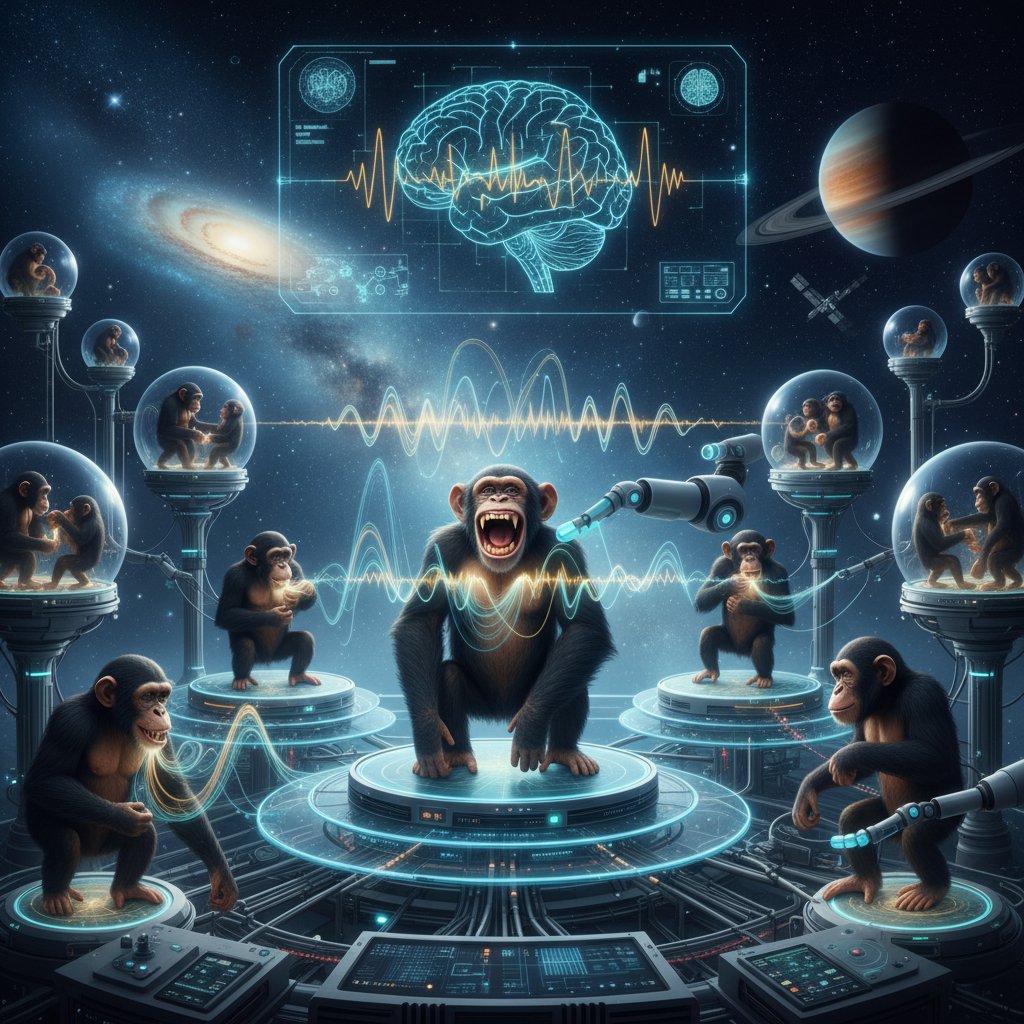
For decades, scientists thought laughter was a uniquely human trait, a byproduct of language and complex cognition. But research on tickled apes is flipping that script. The study, led by Dr. Marina Davila-Ross of the University of Portsmouth’s Department of Psychology, analyzed the vocalizations of 28 great apes — chimpanzees, bonobos, gorillas, and orangutans — as well as 22 human children, all while being tickled. The results? Every single species produced laughter with a shared rhythmic signature: a short, rapid burst of exhaled sounds, almost like a pant, that repeats in a predictable pattern.
“It’s the same basic machinery,” says Dr. Davila-Ross. “The evolutionary roots of human laughter are far older than our species. We’re seeing a common ancestor at work, one that lived around 10 to 16 million years ago.” That ancestor, she explains, likely used this rhythmic vocalization to signal safe play — a sort of “I’m just joking” signal that prevents roughhousing from turning into a real fight. And that’s why tickling works so well: it triggers an involuntary, ancient reflex that we share with our closest relatives.
The Panting Pulse: A Universal Language of Play
Listen closely to a chimpanzee being tickled. You’ll hear a rapid, breathy “ha-ha-ha” — not a full-throated laugh, but something close. That’s because ape laughter is tied to their breathing, specifically to exhalation. Humans, too, laugh on exhalation, but we’ve layered on more vocal control and pitch variation. The study found that human children’s laughter had a wider range of pitches and longer, more complex bursts, but the underlying rhythm — the interval between each “ha” — matched the apes almost perfectly.
To measure this, the researchers recorded the acoustic data and used a computer algorithm to detect patterns. They calculated the “periodicity” — the time between each laugh sound. For humans, it was about 0.2 seconds. For chimpanzees, 0.18 seconds. Bonobos came in at 0.22 seconds. “The numbers are strikingly similar,” says Dr. Davila-Ross. “It suggests that the neural circuits controlling this rhythmic vocalization are highly conserved across species.” In other words, evolution has kept this trait largely unchanged for millions of years, probably because it’s so crucial for social glue.
So what does this mean for you? Next time you’re at a zoo, watch the apes play. That chimp’s “laugh” isn’t just a noise — it’s a direct line to our shared past. And it’s a reminder that joy, at its most primal, is a biological imperative. But here’s the twist: the study also found that humans laugh more often during speech, not just during tickling. We’ve co-opted the ancient laugh circuit for a more modern purpose — conversation. That’s a huge evolutionary leap.
Laughter’s Role in Social Bonding — From Apes to Humans
Laughter isn’t just a response to humor. It’s a social lubricant. When you laugh with someone, you’re signaling trust, belonging, and safety. The same is true for apes. Tickling induces laughter that strengthens bonds between individuals, especially between mothers and infants or between playmates. Dr. Jared Diamond, a renowned physiologist and author of The Third Chimpanzee, once noted that laughter likely evolved to facilitate cooperative behavior in social groups. “Laughter is a vocalization that says, ‘I’m not a threat; let’s play,’” he wrote. This new study backs that up with hard data.
But there’s a darker side. Laughter can also be a tool for exclusion — think of schoolyard bullying or snarky comments. In apes, laughter is almost exclusively tied to positive play. Humans, uniquely, have weaponized it. This divergence is fascinating and points to a complex social evolution. It’s also why the study’s findings matter beyond academia. Understanding the roots of laughter could help treat social disorders like autism, where laughter and play cues often go awry. If we know the baseline rhythm, we can better diagnose when it’s off.
Interestingly, the research team also used a technique called “playback experiments,” where they played recordings of ape laughter to other apes. The apes responded with increased play behavior, suggesting that the sound itself triggers a social response. This is similar to how human babies mimic laughter before they understand jokes. The researchers are now exploring whether this rhythmic laughter is present in other mammals, like dogs or rats, which also produce play vocalizations. (Rats, for the record, laugh in ultrasound frequencies — you can’t hear it without special equipment.)
What This Means for the Evolution of Language
If laughter’s rhythm is ancient, it might also be a precursor to speech. Some linguists argue that language evolved from rhythmic vocalizations — think of chanting, singing, or even the “ha-ha” of laughter. The study adds weight to that theory. The same neural circuits that control laughter’s rhythm could have been repurposed for the rhythmic patterns of speech. “Laughter is a kind of protolanguage,” suggests Dr. Davila-Ross. “It’s a simple, rhythmic signal that conveys emotional state. And from that, more complex vocalizations could have emerged.” This idea isn’t new — Darwin himself speculated about it in The Expression of the Emotions in Man and Animals — but now we have empirical evidence.
Meanwhile, in a completely unrelated but equally fascinating development, researchers at the SETI Institute have proposed a clever fix for the problem of alien signals being drowned out by solar wind. And closer to home, secret cameras and microphones in Cambodia have captured rare wildlife using similar acoustic analysis. But back to laughter: the team is now planning to study laughter in wild apes, not just captive ones, to see if environmental factors change the rhythm. They’re also looking at how laughter differs between cultures — do humans in, say, Japan laugh with the same rhythm as those in Brazil? Early data suggests yes, but with variations in pitch and duration.
So, the next time you hear a baby giggle or a chimp cackle, remember: you’re hearing the echo of a common ancestor. It’s a sound that has been resonating through forests and homes for millions of years. And it’s not just funny — it’s fundamental.
Frequently Asked Questions
Why do we laugh when tickled? Is it a reflex?
Yes, tickle-induced laughter is largely an involuntary reflex, driven by ancient neural circuits that we share with other great apes. It’s thought to have evolved as a social signal for safe play, telling others that the physical contact is not a threat. The rhythmic pattern — the “ha-ha-ha” — is a universal feature across species.
Do all animals laugh?
Not all, but many mammals produce play vocalizations that resemble laughter. Rats, for example, emit ultrasonic chirps when tickled, and dogs have a distinct panting-like sound during play. However, the rhythmic structure studied in great apes and humans appears to be unique to primates, suggesting a shared evolutionary origin.
Could this research help with autism or social anxiety?
Potentially. By understanding the baseline rhythm and social function of laughter, therapists might better identify when these cues are misread or absent in conditions like autism. The research could lead to new interventions that use rhythmic play to improve social bonding, though more studies are needed.