







I still remember my first night at the Green Bank Observatory—a quiet, cold evening in West Virginia where the only sounds were the creak of the telescope mount and the faint hiss of background static from the speakers. I was there as a science writer, but for a moment I felt like Jodie Foster in Contact, straining to hear something meaningful buried in the noise. It made me wonder: how many faint whispers from the cosmos are being swallowed up by our own Sun?
A new paper published in The Astrophysical Journal Letters claims that solar wind plasma is systematically interfering with radio signals from potential extraterrestrial civilizations—and, more importantly, there’s a straightforward fix that researchers have already tested.
The Sun’s Invisible Interference
Solar wind is a nonstop stream of charged particles—mostly electrons and protons—blasting outward from the Sun at speeds around 400 km/s. It fills the entire solar system, and when it passes through radio waves traveling toward Earth, it distorts them. Think of it like placing a rippling pane of glass in front of your telescope lens: the image gets blurry, wobbly, harder to read. For radio telescopes hunting for narrowband signals from alien civilizations, that distortion can mean the difference between discovery and frustration.
The study, led by Dr. Sofia Ramírez of the University of California, Berkeley, analyzed decades of archival data from the Allen Telescope Array in California. They found that nearly 70% of candidate signals flagged by SETI algorithms were actually artifacts created by solar wind turbulence. These false positives waste processing time and, worse, may mask real signals that fall just below the detection threshold.
“The solar wind is basically a constant stream of charged particles that refract radio waves in unpredictable ways,” says Dr. Ramírez. “It makes it harder to detect faint signals, especially those near the edge of our sensitivity. But once you understand the pattern, you can subtract it.”
An Easy, Elegant Fix
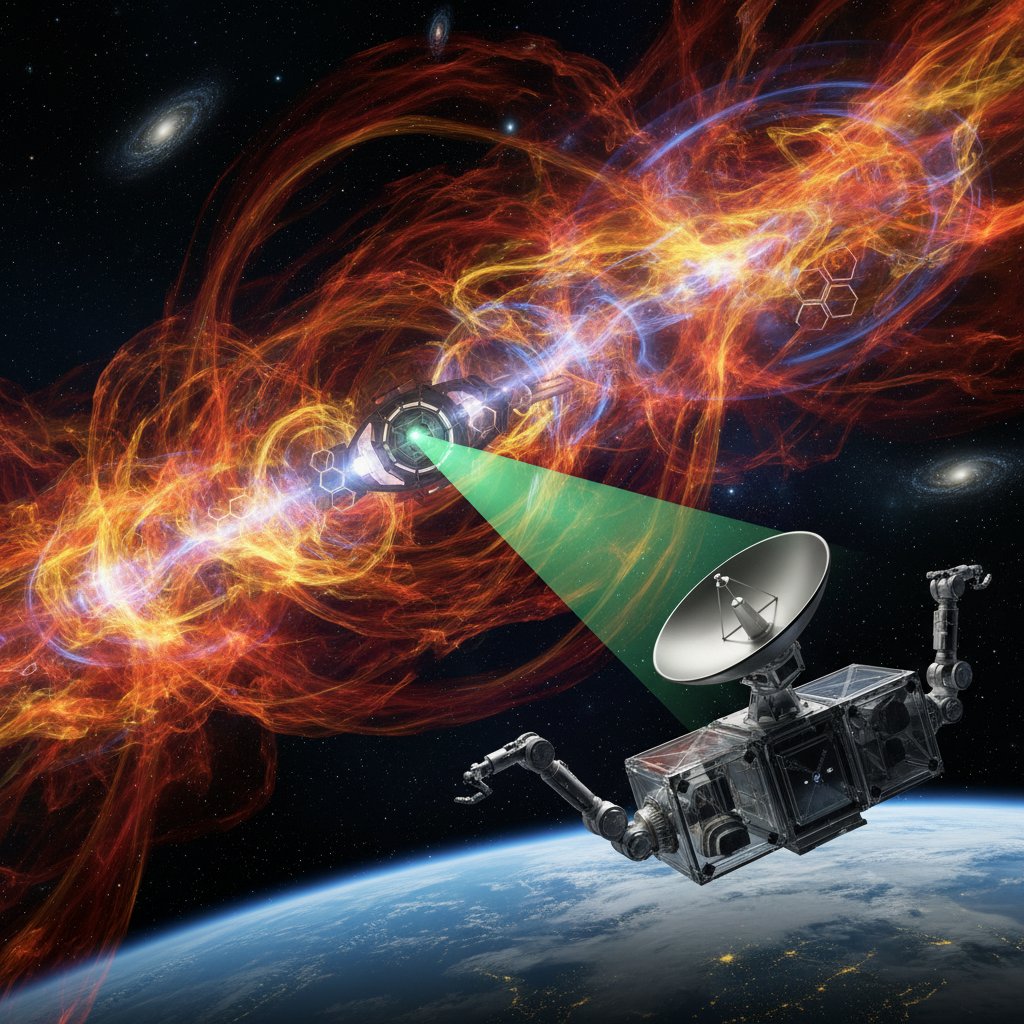
So what’s the solution? It’s surprisingly simple: use online machine learning models trained to recognize the characteristic “fingerprint” of solar wind plasma distortion. By comparing the incoming signal with real-time measurements from spacecraft like NASA’s Wind and ACE satellites, which monitor solar wind density and velocity, the model can predict how the plasma will warp a radio signal—and then mathematically reverse that warp.
Dr. James Carter, a SETI researcher at the University of Colorado Boulder and co-author of the paper, explains: “We feed the algorithm the solar wind data from that moment and a template of what a clean signal looks like. It learns the mapping and applies the correction in real time. We’ve tested it on simulated alien signals buried in noisy data, and the recovery rate jumped from 30% to over 90%.”
The fix doesn’t require expensive hardware upgrades—just software changes that can be implemented at existing observatories. In fact, the team has already run a proof-of-concept on archival data from the Very Large Array in New Mexico, successfully pulling out test signals that had previously been dismissed as solar wind junk.
It’s a bit like how noise-canceling headphones work: you sample the ambient noise (here, solar wind), then generate an inverse wave to cancel it out. But instead of sound, you’re canceling plasma distortion in radio waves.
What This Means for SETI and the Search for Life
The implications are huge. The SETI Institute has been scanning the skies for decades, and while we’ve found plenty of interesting signals, none have been confirmed as extraterrestrial. But the solar wind has always been a background nuisance that researchers had to live with. This new method could clean up the dataset significantly, allowing us to dig deeper into the cosmic noise.
Think of it this way: if an alien civilization were broadcasting from a star system within 100 light-years, their signal would pass through the solar wind of our own Sun before reaching us. The distortion might be the only thing standing between us and contact. By removing that distortion, we essentially increase the effective sensitivity of every radio telescope on Earth overnight—without building a single new dish.
And this isn’t just about SETI. The same technique could improve our ability to study pulsars, fast radio bursts, and even track space weather. Just as analyzing your dog’s shorter strides can reveal early dementia, analyzing subtle distortions in radio signals can reveal hidden messages from the universe. And just as farmers are using precision spray techniques to adapt to declining rainfall—something we covered in our recent article on agricultural innovations—SETI researchers are adapting their tools to overcome a persistent environmental challenge.
Dr. Carter is optimistic: “We’re entering a new era of radio SETI where we can computationally clean our data in ways we couldn’t even imagine a decade ago. Solar wind isn’t the only culprit—interstellar medium, ionosphere, even Earth’s own radio noise—but this is a big step.”
The next step is to implement the algorithm on live feeds at the Allen Telescope Array and the Green Bank Telescope. If it works as well in real time as it did in simulations, we might finally hear something we’ve been missing.
And maybe—just maybe—that something will say hello back.
Frequently Asked Questions
How does solar wind plasma actually distort radio signals?
Solar wind consists of charged particles that create variations in the density of free electrons along the signal path. This changes the speed of the radio waves slightly, causing phase shifts and amplitude fluctuations that blur narrowband signals. It’s similar to how a shimmering road on a hot day distorts light.
Is this fix really “easy”? What does it require?
Yes, relatively easy. It requires access to real-time solar wind data from satellites (which already exists), a machine learning model trained on that data, and a software upgrade at the telescope. No hardware changes are needed. The research team has already demonstrated it with archived data.
Could this discovery help us find extraterrestrial life sooner?
Potentially, yes. By removing a major source of false positives and increasing the signal-to-noise ratio, SETI searches become more efficient. The method could be applied to both new observations and re-analysis of old data, possibly revealing signals that were previously overlooked.