







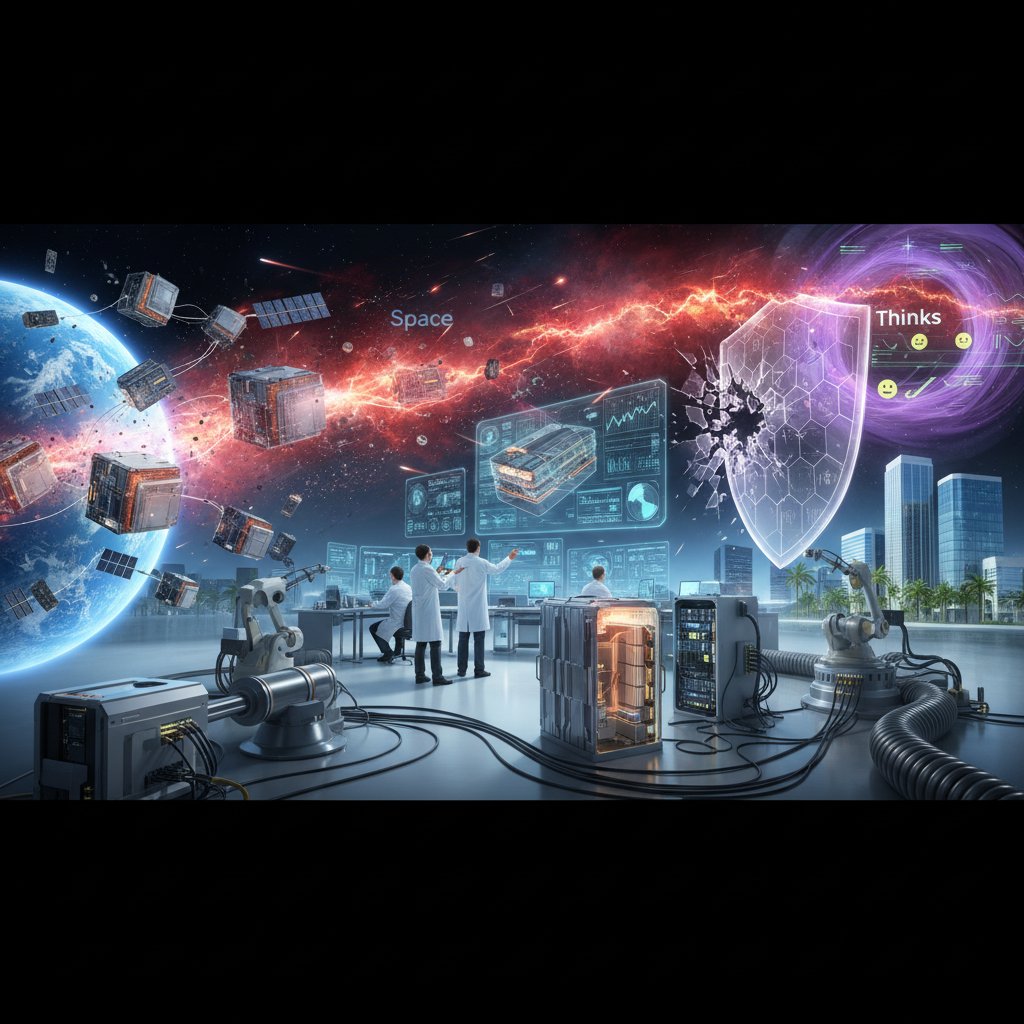
Imagine a world where your Netflix stream never buffers, AI models train in minutes, and global data flows at the speed of light—all from a server farm orbiting Earth. It sounds like a sci-fi utopia, and Silicon Valley is pouring billions into making it real. But here’s the uncomfortable truth: orbital data centers are far harder than the tech industry thinks.
From blistering radiation to astronomical launch costs, the challenges of running a data center in space are enough to make even Elon Musk wince. For everyday people, the promise of seamless connectivity and cheaper cloud services is tantalizing. Yet behind the hype, engineers are grappling with physics that doesn’t bend to venture capital enthusiasm. The most immediate impact for you? Your data might soon travel through space, but don’t expect lower prices or flawless performance anytime soon.
This isn’t just a technical hurdle; it’s a fundamental rethinking of how we compute. Let’s break down why orbital data centers are harder than Silicon Valley thinks—and why that might be a good thing.
The Cosmic Radiation Problem: Your Servers Are Toast
Here’s the first gut punch: space is a hostile environment. On Earth, data centers are shielded by our atmosphere and magnetic field, which block most harmful radiation. In orbit, there’s no such protection. Cosmic rays and solar particles constantly bombard electronics, causing bit flips—single-event upsets that corrupt data. For a server farm running millions of transactions per second, that’s a disaster.
“Radiation is the silent killer of orbital computing,” explains Dr. Lena Petrova, a space systems engineer at the European Space Agency. “A single high-energy particle can crash a server or corrupt a file. To mitigate this, you need radiation-hardened components, which are 10 to 100 times more expensive than commercial-grade hardware. And even then, you’re facing frequent reboots and data integrity issues.”
The cost of hardening electronics is staggering. A typical terrestrial data center server costs around $5,000. A radiation-hardened equivalent can run $50,000 to $500,000 per unit. Multiply that by thousands of servers, and the economics break down. Worse, hardened chips are often years behind consumer tech in performance—your smartphone might be more powerful than a space-grade processor. For AI workloads that demand cutting-edge GPUs, this is a non-starter.
But it gets worse. Solar flares can spike radiation levels by orders of magnitude, forcing entire data centers to shut down. This isn’t theoretical; in 2022, a solar storm knocked out 40 Starlink satellites. Now imagine that happening to a $10 billion orbital data center. The result: mass data loss and service outages that would make a blue screen of death look quaint.
Launch Costs and the Gravity of Economics
Silicon Valley loves to talk about SpaceX’s Starship slashing launch costs. And yes, Starship aims to bring costs down to $10 per kilogram—a fraction of today’s $2,700 per kilogram on Falcon 9. But even at $10/kg, launching a single data center module is eye-watering. A typical terrestrial data center weighs hundreds of tons. A modest orbital facility, say 50 tons, would cost $500 million in launch fees alone—before you’ve installed a single server.
And that’s just the first launch. Orbital data centers require regular maintenance, upgrades, and cooling. Yes, cooling. In the vacuum of space, you can’t just blow air over a hot server. You need radiators, heat pipes, or even liquid cooling loops, all of which add mass and complexity. “Cooling in space is a nightmare because there’s no convection,” notes Dr. Marcus Okonkwo, a thermal engineer at NASA’s Jet Propulsion Laboratory. “You have to radiate heat away, which requires large surface areas and careful thermal management. A single cooling failure can cascade into a catastrophic meltdown.”
Then there’s the issue of power. Solar panels can provide electricity, but they degrade quickly in orbit due to radiation. A typical panel loses 10% efficiency per year. To maintain performance, you’d need to replace them frequently—again, requiring costly launches. Some companies propose nuclear reactors, but that adds regulatory hurdles and safety risks. The bottom line: the economics of orbital data centers don’t pencil out unless launch costs drop by another 90% and hardware lasts decades. That’s a big if.
The Latency Mirage: Space Isn’t Faster for Everyone
The biggest selling point of orbital data centers is low latency. Light travels faster in vacuum than in fiber optic cables, so a satellite in low Earth orbit (LEO) can theoretically reduce data transit times. For high-frequency trading or real-time gaming, that’s a game-changer. But here’s the catch: latency depends on where you are. For users in rural areas or developing nations, the signal must travel from your device to a ground station, then up to the satellite, then to another ground station, and finally to the data center. That round trip can actually be slower than terrestrial fiber for long distances.
“The latency advantage is real but narrow,” says Dr. Yuki Tanaka, a network engineer at the University of Tokyo. “For users within a few hundred kilometers of a ground station, orbital data centers can shave off 10-20 milliseconds. But for the majority of the planet, the link budget—the signal strength and path length—adds delays that cancel out any gain. You’re not going to get sub-millisecond response times from orbit unless you’re sitting under the satellite.”
Moreover, orbital data centers introduce new bottlenecks. Data must be beamed down via radio or laser links, which have limited bandwidth compared to fiber. A single laser link might handle 10-100 Gbps, while a terrestrial fiber bundle can carry petabytes per second. To compete, you’d need constellations of thousands of satellites with massive optical interconnects—a logistical and engineering nightmare. The reality is that orbital data centers might excel for niche applications like weather modeling or global IoT, but they won’t replace your local server farm anytime soon.
What This Means for You: Patience, Not Panic
So, should you cancel your cloud subscription? Absolutely not. Orbital data centers are coming, but slowly. Companies like Amazon, Microsoft, and Lumen are investing in R&D, and the U.S. Space Force is funding testbeds. The first orbital data centers might launch by 2030, but they’ll be small, experimental, and focused on specific tasks like disaster recovery or edge computing. For the average user, the impact will be invisible—your emails, videos, and apps will still run on terrestrial servers for at least a decade.
What these challenges mean is that innovation will force Silicon Valley to think harder. Radiation-hardened chips might trickle down to consumer electronics, making your laptop more durable. Cooling breakthroughs could improve data center efficiency on Earth. And the push for better launch systems will accelerate space exploration for everyone. It’s a classic case of technology driving progress through adversity.
The dream of orbital data centers isn’t dead—it’s just harder than the hype suggests. And that’s okay. The best innovations are born from overcoming impossible problems. So next time you see a headline about data centers in space, remember: the future is coming, but it’s going to take a lot more than Silicon Valley optimism to get there.