








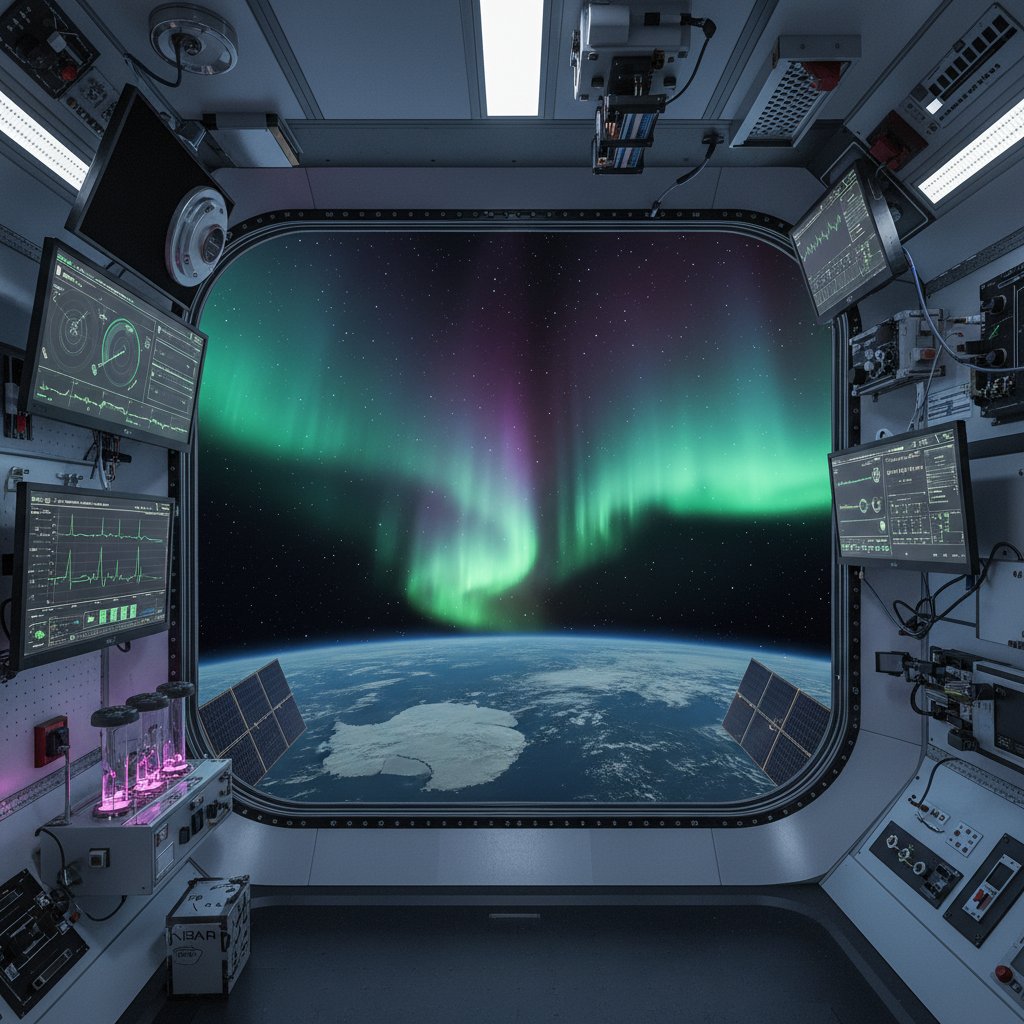
If you thought the Northern Lights were spectacular, wait until you see their southern counterpart from orbit. A newly released timelapse filmed from SpaceX’s Dragon spacecraft offers an unprecedented, high-definition view of the aurora australis—the Southern Lights—dancing across the Antarctic sky. The footage, captured by astronauts during a routine reboost maneuver, has already racked up millions of views online and is giving scientists a fresh perspective on Earth’s magnetic ballet.
The timelapse shows shimmering curtains of green and red light rippling over the southern polar region, with the curvature of Earth providing a stunning backdrop. Unlike ground-based views, this orbital perspective reveals the full scale of the aurora—a phenomenon that spans thousands of kilometers and reaches altitudes of up to 600 kilometers. For those of us who may never set foot in Antarctica, the video is a visceral reminder of the dynamic planet we inhabit.
But beyond the visual spectacle, the footage has real scientific value. Researchers are using it to study the relationship between solar wind activity and auroral intensity, as well as the structure of the magnetosphere. “This is like having a weather satellite that follows the lights in real time,” says Dr. Sarah Jones, an auroral physicist at the University of Alaska Fairbanks. “From the Dragon, you see the aurora as a continuous, evolving system—not just a static snapshot from the ground.”
A View Like No Other
The Dragon spacecraft, developed by SpaceX, has been ferrying astronauts and cargo to the International Space Station (ISS) since 2012. While the ISS itself is a frequent host for aurora photography, Dragon’s unique position during certain maneuvers—such as when it separates from the station or performs orbital adjustments—offers a different vantage point. The timelapse in question was taken during a recent mission, likely from the spacecraft’s cupola window, providing an unobstructed view of Earth.
“The camera was set to capture one frame every few seconds, then compiled into a video that compresses hours into minutes,” explains Dr. Michael Brown, an astrophysicist at MIT who specializes in orbital imaging. “The result is a hypnotic flow of light that shows how auroras are not static—they breathe, pulse, and shift in response to solar storms.” The footage includes rare frames of a so-called “diffuse aurora,” a faint, less-studied form that appears as a steady glow rather than distinct curtains.
For the astronauts aboard, filming such sequences is both a scientific task and a deeply personal experience. “You can’t help but stare,” one crew member remarked during a press conference. “It’s like the planet is alive.”
What Makes the Southern Lights Different?
Most people are familiar with the aurora borealis, which dominates headlines from Scandinavia to Canada. The aurora australis, however, is less accessible—it hugs the coast of Antarctica and the southern tips of New Zealand, Australia, and South America. But physically, both are born from the same process: charged particles from the Sun (the solar wind) collide with Earth’s magnetic field, funneling toward the poles and exciting oxygen and nitrogen molecules in the upper atmosphere.
“The Southern Lights are often more intense during certain phases of the solar cycle because the magnetic field geometry is slightly different near the South Pole,” notes Dr. Jones. “This timelapse captures that intensity beautifully.” The footage shows bright red emissions at higher altitudes (from oxygen at 200–300 km) and green lower down (from oxygen at around 100 km). Nitrogen produces blue and purple hues, though these are less visible in the video.
Because the Dragon spacecraft orbits at roughly 400 km altitude, it flies directly through the auroral zone, offering a perspective that ground observers can only dream of. “From the ground, you look up and see a thin ribbon. From space, you look down and see the entire ring of light encircling the pole,” says Dr. Brown. “It’s like comparing a firefly in your backyard to the entire night sky.”
The Science Behind the Spectacle
Beyond the beauty, the timelapse is a treasure trove of data. By analyzing the movement and color distribution, scientists can infer the energy of incoming particles and the density of atmospheric gases. For example, the ratio of red to green light indicates how energetic the solar wind was when it hit the magnetosphere. “We can calibrate our models using this footage,” explains Dr. Jones. “It’s like having a high-resolution laboratory experiment run by nature itself.”
The timing of the capture is also significant. We are currently approaching the solar maximum (expected in 2025), when solar activity peaks. This means more frequent and intense auroral displays. The Dragon timelapse serves as a preview of what’s to come—and a call to action for researchers to prepare. “We need more such observations from different orbital platforms,” says Dr. Brown. “SpaceX’s Dragon is proving to be an excellent platform for citizen science and professional research alike.”
What This Means for Space Exploration
The release of this timelapse is not just a viral moment; it’s a sign of how commercial spaceflight is democratizing access to Earth observation. As SpaceX continues to launch private missions—including the upcoming Polaris Dawn and DearMoon projects—more opportunities arise for astronauts and even trained civilians to capture scientific data. “Every Dragon mission could be a chance to film the aurora,” says Dr. Jones. “We should encourage crews to set aside time for this kind of photography.”
Looking forward, the footage also underscores the importance of preserving dark skies and monitoring space weather. As our reliance on satellites grows, understanding auroral dynamics helps protect communications and GPS systems. “The aurora is beautiful, but it’s also a warning,” says Dr. Brown. “Solar storms can disrupt our technology. Timelapses like this remind us that we live in the atmosphere of a star.”
For now, the video offers a moment of wonder—a chance to see our planet from a perspective few will ever experience. As the Dragon capsule continues its missions, we can expect more such gems. The Southern Lights, once the domain of polar explorers and satellite instruments, are now accessible to anyone with an internet connection. And that, perhaps, is the most exciting development of all.