







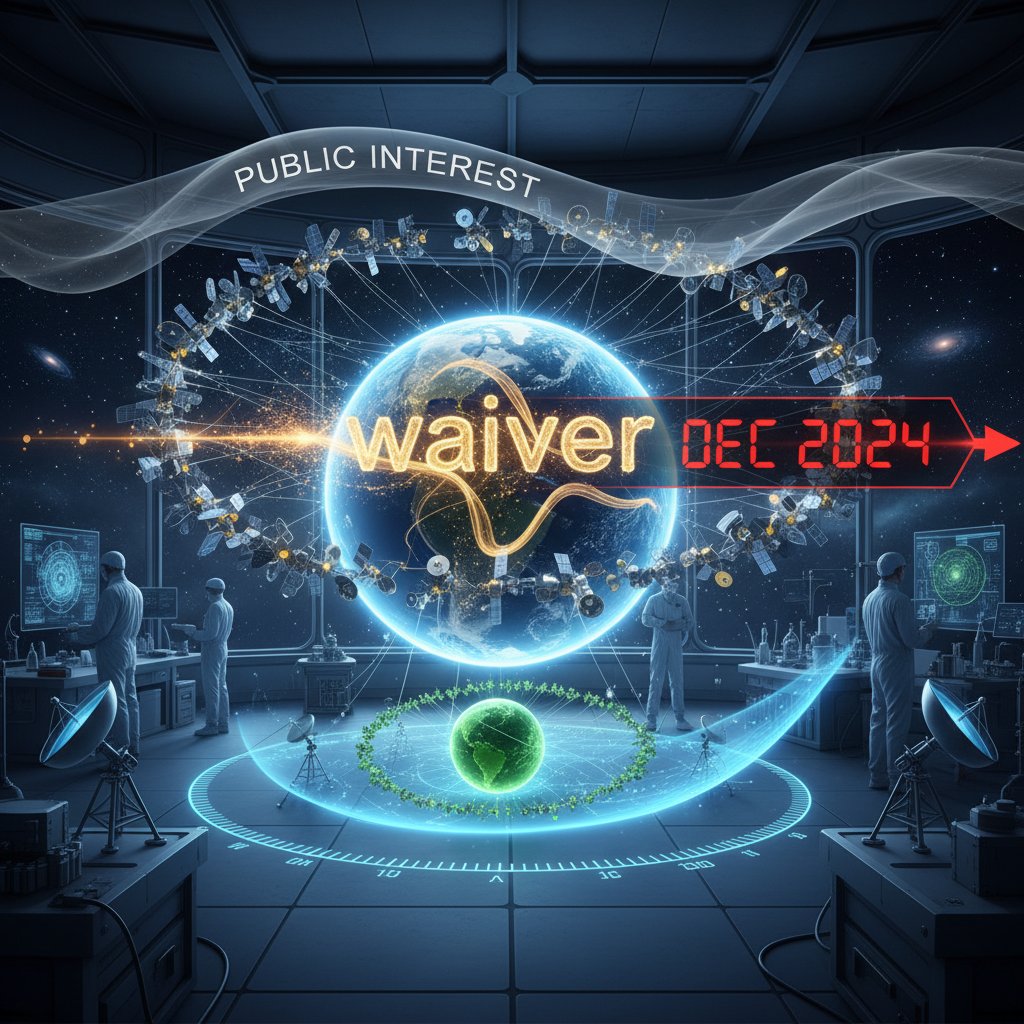
On February 15, 2024, the Federal Communications Commission (FCC) granted Amazon a critical waiver, lifting the looming deadline that threatened to derail its Project Kuiper satellite broadband constellation. This decision ensures that the tech giant can continue deploying its 3,236 low-Earth orbit (LEO) satellites without facing immediate penalties, a move the FCC itself declared “serves the public interest by promoting a second large satellite broadband constellation.”
The waiver arrives at a pivotal moment. Amazon had been racing against a 2026 deadline to launch half of its Kuiper fleet—a requirement from its 2020 FCC license. Without the extension, the company risked forfeiting its spectrum rights and facing billions in sunk costs. Now, with the FCC’s green light, Amazon can strategically pace its launches, potentially reshaping the global broadband landscape in the process.
But why should you care? Because space-based internet is no longer a sci-fi fantasy—it’s a rapidly maturing industry. SpaceX’s Starlink already serves over 2 million subscribers, and one competitor is good, but two? That’s a recipe for competition, lower prices, and expanded coverage. Let’s dive into what this waiver really means and how it could bring high-speed internet to the most remote corners of the world.
From Deadline to Lifeline: What the FCC Changed
Amazon’s original FCC license, granted in 2020, required the company to launch 50% of its satellites by July 2026. With only a handful of test satellites currently in orbit—the two successful launches in October 2023—Amazon was clearly behind schedule. The FCC’s waiver extends that milestone to 2029, giving Kuiper three additional years to catch up.
“This isn’t an open checkbook,” said FCC Chairwoman Jessica Rosenworcel in a statement. “We’re carefully balancing the need for timely deployment with the benefits of fostering competition in the broadband marketplace. Amazon must still meet rigorous benchmarks, but this flexibility ensures they can build a system that meets technical and operational standards.” The conditions: Amazon must demonstrate progress every six months, and the FCC retains the right to revoke the waiver if milestones are missed.
Industry analysts see this as a win for regulatory pragmatism. “The FCC looked at a one-constellation future—Starlink dominating LEO—and blinked,” noted Dr. Helena Reeves, a space policy expert at the University of Texas. “By keeping Amazon in the game, the commission ensures that rural broadband access won’t become a monopoly.”
Project Kuiper vs. Starlink: A Cosmic Rivalry Takes Shape
SpaceX’s Starlink currently holds a commanding lead with over 5,500 operational satellites. But Amazon isn’t just playing catch-up—it’s aiming for a different architecture. Kuiper’s satellites operate at altitudes between 590 and 630 kilometers, slightly higher than Starlink’s 550 km, which could reduce collision risks and improve coverage over equatorial regions.
Amazon has already invested over $10 billion into the project, including a massive deal with United Launch Alliance (ULA) for up to 47 rocket launches. Last October, the company successfully tested two prototype satellites, achieving speeds of up to 1 Gbps and latency as low as 20 milliseconds. “We’re moving with urgency,” said David Limp, Amazon’s former hardware chief, during a 2023 industry conference. “Kuiper isn’t about catching up to Starlink—it’s about bringing genuine competition to a market that needs it. More players mean better service for everyone.”
The rivalry is already spurring innovation. Starlink recently dropped its hardware prices in some regions, and Amazon has promised to offer terminals costing under $400, compared to Starlink’s current $599. For consumers in rural Montana or remote villages in Kenya, that price difference could be life-changing.
Why This Matters for Earth’s Underserved Communities
The FCC’s decision isn’t just about corporate timelines—it’s about bridging the digital divide. According to the International Telecommunication Union, 2.6 billion people globally remain offline, with rural areas suffering the worst access. Traditional fiber networks are expensive to lay, especially across oceans, mountains, or sparsely populated terrain. LEO constellations, by contrast, can beam connectivity anywhere on the planet.
Amazon has already signed agreements with Verizon and local ISPs in emerging markets to distribute Kuiper capacity. In a 2023 whitepaper, the company estimated its constellation could connect up to 200 million people in remote regions by 2030. Dr. Raj Patel, a telecommunications engineer at MIT, is cautiously optimistic: “The physics works, but the economics are brutal. Amazon needs to prove it can manufacture thousands of satellites at scale—something only SpaceX has done. This waiver buys them time to set up their production line in Kirkland, Washington, which is expected to churn out 5 satellites per day by 2025.”
He adds: “If Amazon succeeds, the impact could be profound. Imagine a school in rural Zambia with the same internet speed as a school in Tokyo. That’s the promise of LEO broadband, and competition between Starlink and Kuiper makes it more likely to happen.”
The Road Ahead: What to Watch in 2024-2025
With the waiver secured, Amazon faces a compressed but achievable schedule. The company aims to launch its first batch of production satellites later this year, with commercial service potentially starting in 2025. A key milestone will be the deployment of the first 578 satellites, which represents the minimum needed to provide initial service across select latitudes.
However, challenges remain. The ULA’s Vulcan rocket, Amazon’s primary ride to orbit, suffered delays last year. Amazon has also booked launches with Blue Origin (its sister company) and Arianespace, but any further rocket failures could ripple through the timeline. Meanwhile, environmental groups are raising concerns about light pollution and space debris—issues that both Amazon and SpaceX must address transparently.
Yet the forward-looking tone from FCC and Amazon suggests optimism. “This is the dawn of a new era in connectivity,” said Commissioner Geoffrey Starks during a public hearing. “Two giant constellations, competing and cooperating, will push the boundaries of what’s possible. And the public, especially those left behind by terrestrial networks, will be the ultimate beneficiaries.”
As for Amazon, the message is clear: the company plans to make Kuiper a defining part of its ecosystem, integrating with AWS cloud services and potentially powering autonomous delivery drones. If the next few years go according to plan, the night sky will soon have two networks of blinking lights—each one a bridge to a more connected world.