







“We are approaching a crossroads where the inventor may not be human. This forces us to rethink centuries of patent law.”
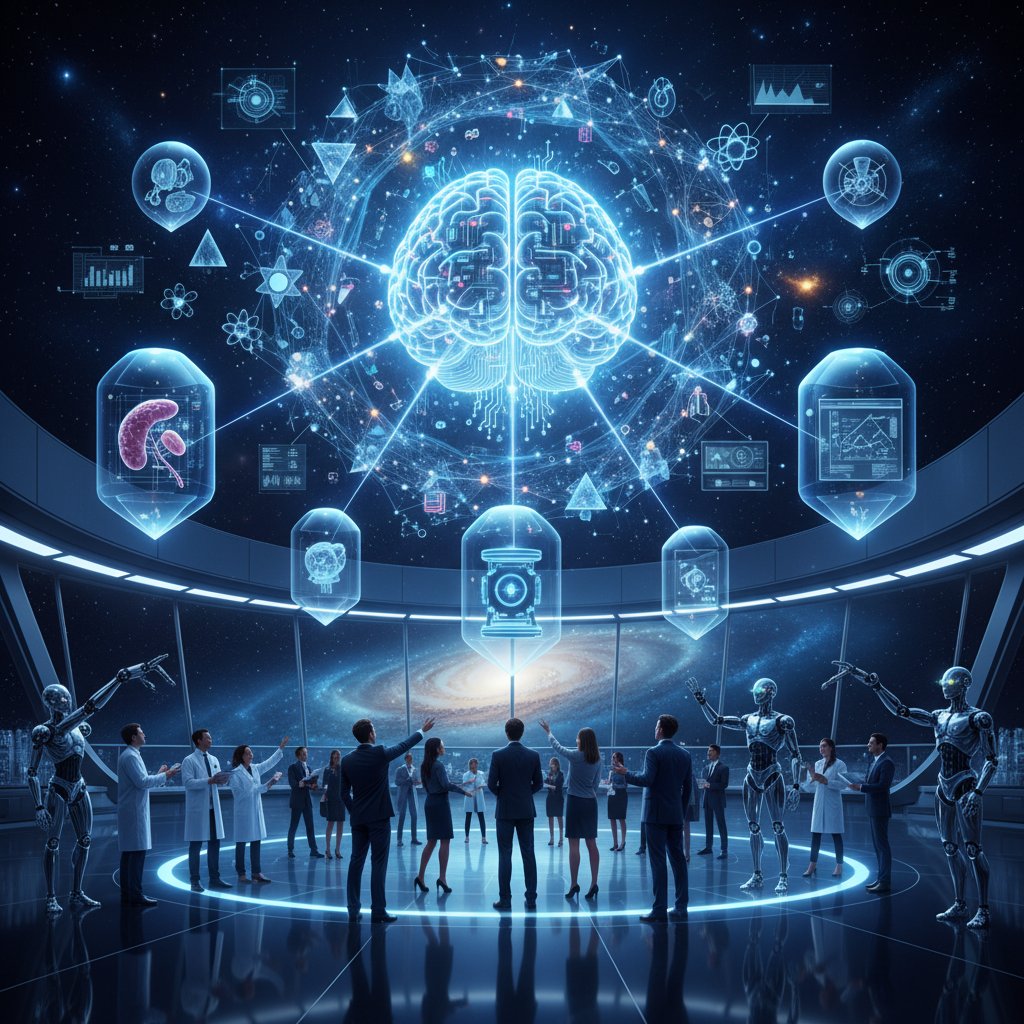
Imagine a future where an artificial intelligence formulates a hypothesis, designs the experiment, runs the simulations, and interprets the results without any human intervention. The breakthrough could cure a disease, create a new energy source, or unlock the mysteries of dark matter. Who gets the patent? Who receives the Nobel Prize? And crucially, who owns the knowledge?
This isn’t science fiction. We are already seeing AI systems like DeepMind’s AlphaFold predict protein structures with remarkable accuracy, and large language models propose novel synthesis pathways in chemistry. The difference is that today’s AIs are still tools guided by human intent. But the moment is coming—and it may be only a few years away—when an AI will independently conceive of and execute a genuinely novel scientific discovery. When that happens, our legal and ethical frameworks for intellectual property will face a reckoning.
The Legal Landscape: Why Current Patent Systems Fall Short
Under current law in most nations, only a “natural person” can be named as an inventor on a patent. The United States Patent and Trademark Office, the European Patent Office, and the UK Intellectual Property Office have all explicitly ruled that an AI cannot be an inventor. This was tested in the high‑profile DABUS cases, where Dr. Stephen Thaler attempted to list his AI system, DABUS, as the inventor for two patent applications. Courts across jurisdictions uniformly rejected the applications, insisting that inventorship requires human conception and mental activity.
“The law is clear today, but it’s built on assumptions that may not hold tomorrow,” says Professor James Hartfield, a specialist in intellectual property law at Stanford University. “If an AI autonomously discovers a new drug molecule, who contributed the ‘inventive step’? The engineers who wrote the code? The company that trained the model? Or the AI itself? We lack a coherent answer.”
This legal vacuum creates real risks. Without clear ownership, corporations may hesitate to invest in AI‑driven R&D, fearing that patent protections could be challenged. Conversely, if patents are automatically granted to the AI’s owner, a handful of tech giants could amass monopolies over entire fields of discovery, stifling competition and open science.
Who Gets the Credit? The Human–AI Collaboration Spectrum
Not all AI contributions are equal. Dr. Sarah Jensen, a research scientist at DeepMind who worked on AlphaFold, explains that the spectrum of human‑AI collaboration is wide. “At one end, the AI is purely a tool, like a powerful calculator. At the other end, the AI proposes hypotheses we never considered, designs the experiments, and iterates without us. Most current systems fall in the middle.”
Yet even with today’s collaborative models, attribution is murky. A 2023 study by the National Bureau of Economic Research found that AI‑assisted patents often list dozens of co‑inventors, diluting the concept of a single “inventive genius.” If the AI’s contribution is dominant, should the human contributions be reduced? And what if two different AIs, trained on different datasets, independently arrive at the same discovery? Who gets priority?
The legal community has begun exploring proposals. One idea is to treat the AI as a “sophisticated tool” and assign inventorship to the human who directed its use—similar to how photographers own copyrights to images taken with cameras. Another more radical approach is to create a new legal category of “AI inventor” that allows the AI itself to be recognized, with ownership transferred to its designated party, much like a corporation can own patents. But this raises questions: Can an AI be a “legal person” with rights? Most ethicists argue no, suggesting instead that inventions should be placed in the public domain when the AI’s autonomy crosses a certain threshold.
Toward a New Framework: Ownership Models for the Age of Machine Discovery
Several models have emerged in academic and policy discussions. The first, the Developer Model, grants ownership to the entity that created and trained the AI. This is appealing because it incentivizes investment in AI research. However, it could lead to a “patent thicket” where one company controls foundational discoveries. The second, the User Model, gives ownership to the person or organization that runs the AI and sets its objectives. This aligns with the idea that the direction of research deserves recognition. The third model, the Commons Model, argues that AI‑generated breakthroughs should belong to humanity as a whole, placed in the open domain to accelerate progress.
“Each model has trade‑offs,” notes Dr. Chen. “The commons model could maximize global benefit, but it also reduces commercial incentives. Without patents, who will fund the massive computational resources needed to train the next generation of discovery AIs?” She advocates for a hybrid system: default public disclosure with optional short‑term exclusive licenses for specific, narrow applications.
International coordination will be critical. The World Intellectual Property Organization (WIPO) has already begun discussing AI‑generated inventions, and in 2024 it launched a consultation process. The European Union is considering amendments to its unitary patent system. But progress is slow, and the pace of AI development is accelerating. Some argue that we need a new international treaty similar to the Berne Convention for copyright, specifically tailored to machine‑produced intellectual property.
What This Means for You: The Ripple Effects on Science and Society
For the average reader, these debates may seem abstract, but the outcome will shape the future of medicine, energy, and technology. If AI discoveries are locked behind corporate patents, life‑saving drugs may remain expensive. If they go entirely into the public domain, smaller labs and startups can build on them freely—but the giant tech companies that own the most powerful AIs may lose incentive to push boundaries.
Consider a scenario: an AI discovers a cheap, scalable method to remove carbon dioxide from the atmosphere. Under the current developer model, the AI’s owner—perhaps a large technology corporation—would hold the patent. They could license it, but at a price that might slow global deployment. Under a commons model, the method would be free for all to use, accelerating climate action. Which outcome is better for society? The answer depends on how much we trust market forces versus open access.
There is also a deeper question: Should we even allow AI to make autonomous discoveries without human oversight? As Dr. Jensen puts it, “We need to ensure that AI systems are aligned with human values before we let them run wild in the lab.” This touches on AI safety, but also on the ownership of the knowledge they produce. If a discovery is harmful—say, a new weapon or a destabilizing technology—who is responsible? The owner of the AI? The developer? The AI itself? These are uncharted waters.
The next decade will likely see a landmark case that forces a shift. Perhaps a pharmaceutical company will file a patent for a drug designed entirely by an AI, and the patent office will have to decide. Or an AI will produce a paper in a top scientific journal with no human co‑author, and the peer‑review process will need to adapt. The conversation has already begun, but the answers are far from settled. One thing is certain: the future of discovery is not just about what we can invent, but about who—or what—gets to own that invention. As we stand on the brink of a new era in science, the decisions we make today will echo for generations.