If you’ve ever dreamed of seeing the northern lights without trekking to the Arctic Circle, now might be your chance. In a stunning display of stellar power, the Sun erupted with three colossal solar flares in less than 24 hours, dramatically boosting the chances for aurora borealis displays across the northern United States, Canada, and the United Kingdom. For millions of people, the night sky could soon be painted with shimmering curtains of green, purple, and red.
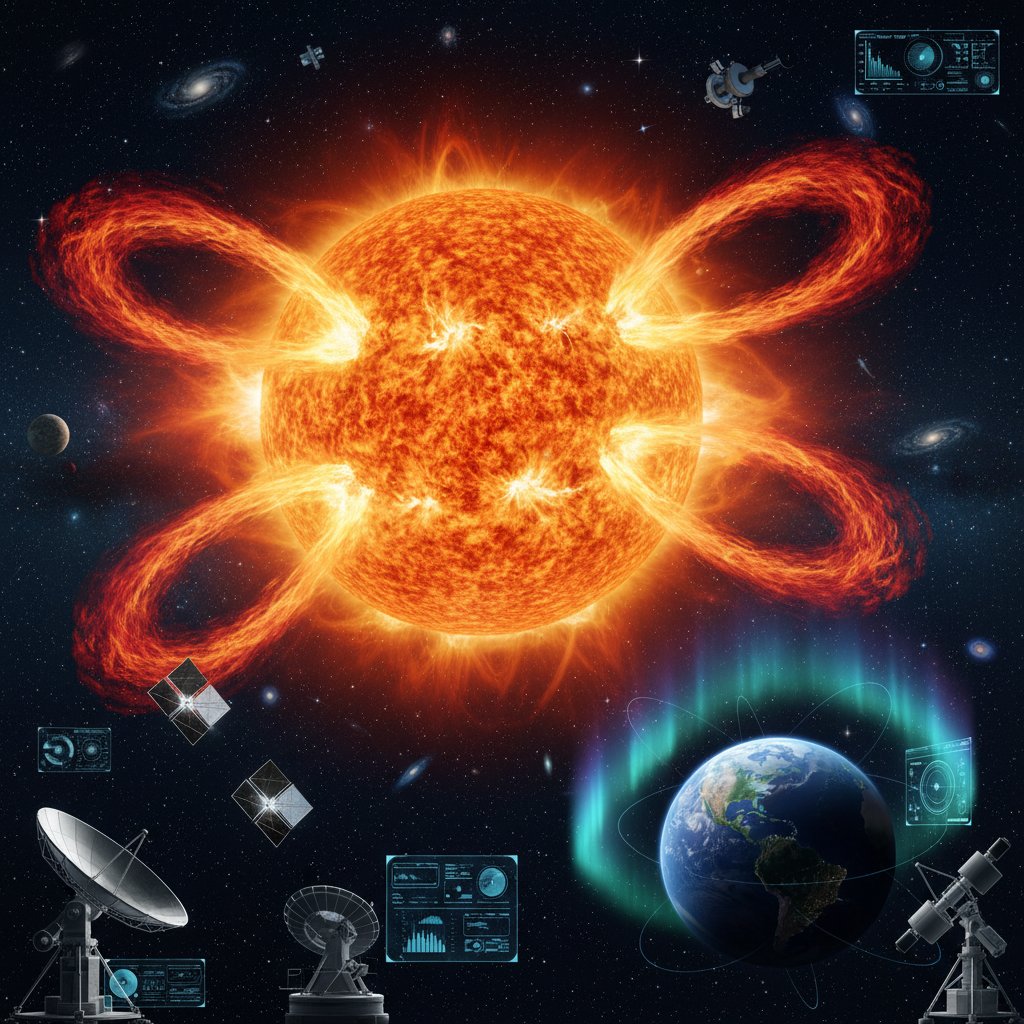
The triple eruption—which began on March 28, 2025, and continued into the early hours of March 29—originated from a highly active sunspot region designated AR4046. The flares were classified as X-class, the most powerful category on the solar flare scale. The first, an X1.2 flare, was followed by an X2.1 and then an X1.8, each sending a burst of high-energy radiation and charged particles hurtling toward Earth.
“Three X-class flares within a single day is rare, even during the solar maximum,” said Dr. Sarah Johnson, a solar physicist at NOAA’s Space Weather Prediction Center in Boulder, Colorado. “We’re now seeing the cumulative effect of these eruptions, which means a higher probability of strong geomagnetic storms in the next 48 to 72 hours.”
A Triple Solar Salvo
The Sun is currently ramping up toward the peak of its 11-year activity cycle, known as the solar maximum. This period is characterized by an increase in sunspots, flares, and coronal mass ejections (CMEs)—massive expulsions of plasma and magnetic fields. The recent flurry of activity from AR4046 has already produced at least two Earth-directed CMEs, which are now racing across interplanetary space at speeds exceeding 1,000 kilometers per second.
According to the Space Weather Prediction Center, the first CME is expected to arrive late on March 30, with a second following closely behind. When these clouds of charged particles slam into Earth’s magnetosphere, they can trigger geomagnetic storms—the engine behind the northern and southern lights.
“The combination of multiple CMEs can lead to a phenomenon called ‘cannibal CME,’ where a faster CME overtakes a slower one, creating a powerful, merged disturbance,” explained Dr. Mark Thompson, an astronomer and author specializing in aurora observation. “That can supercharge the resulting geomagnetic storm and push the aurora oval much farther south than usual.”
Forecast models suggest that if the CMEs merge, the geomagnetic storm could reach G3 (strong) to even G4 (severe) levels on the five-point Kp index. At G4, the aurora can be visible as far south as Oregon, Illinois, and New York in the United States, and across much of England and Scotland.
What This Means for the Northern Lights
For skywatchers, this is a rare opportunity. The aurora borealis is typically confined to high-latitude regions near the Arctic Circle, but during strong geomagnetic storms, the auroral oval expands equatorward. The upcoming event could bring vivid displays to areas that rarely see them.
“If you live in the northern half of the United States, from the Pacific Northwest to the Great Lakes and New England, you should be watching the skies on the nights of March 30 and 31,” said Thompson. “Even in the UK, if the storm hits hard, you might catch the lights from Scotland, northern England, and possibly as far south as the Midlands.”
The key to seeing the aurora is a clear, dark sky away from city lights. The best viewing times are typically between 10 p.m. and 2 a.m. local time. Smartphone cameras are surprisingly sensitive to aurora, so even if the display is faint to the naked eye, a long-exposure photo might reveal a green glow.
NOAA’s Space Weather Prediction Center will issue real-time alerts and a 30-minute forecast of auroral activity. Enthusiasts can also follow the OVATION model, which predicts the aurora’s intensity and location based on current solar wind conditions.
The Science Behind the Flares
Solar flares are intense bursts of radiation originating from the release of magnetic energy associated with sunspots. They are classified into A, B, C, M, and X categories, with X being the most powerful. Each step up represents a tenfold increase in energy output. The three flares on March 28–29 all exceeded X1, meaning they are among the strongest events of the current solar cycle.
These flares are often accompanied by CMEs, which can cause geomagnetic storms when they interact with Earth’s magnetic field. The strength of the storm depends on the speed, density, and magnetic orientation of the CME. A southward-pointing magnetic field is particularly effective at coupling with Earth’s magnetosphere and funneling energy into the upper atmosphere.
“We’re monitoring the interplanetary magnetic field closely,” said Johnson. “If the Bz component turns southward upon arrival, we could see a spectacular auroral display. But even if it’s not perfect, the sheer number of flares means there’s a good chance of some activity.”
The current solar cycle, Cycle 25, has already exceeded initial predictions for sunspot counts. Scientists have noted that the Sun seems to be more active than anticipated, with X-class flares occurring more frequently than in the previous cycle. This trend is expected to continue through 2025 and into 2026.
What’s Next for Space Weather
While the aurora is a beautiful natural phenomenon, space weather events of this scale also have practical implications. Strong geomagnetic storms can disrupt satellite communications, GPS signals, and even power grids. In 1989, a G5 storm caused a nine-hour blackout in Quebec, Canada. The current event is not expected to reach that intensity, but operators of sensitive infrastructure are on alert.
“We’ve already notified power grid operators and satellite companies to prepare for possible fluctuations,” Johnson said. “For most people, the biggest impact will be the aurora, but we always take precautions.”
For now, the focus is on the skies. Amateur astronomers and aurora chasers are already packing their cameras and heading to dark-sky sites. Social media groups dedicated to northern lights viewing are buzzing with excitement, sharing maps and predictions.
“This is what makes space weather so thrilling,” said Thompson. “The Sun gives us a reminder that we live on a dynamic planet, connected to a dynamic star. And sometimes, that connection paints the sky with light.”
If the CMEs arrive as forecasted, the next few nights could offer an unforgettable show. Keep your eyes on the north—and your phone charged for photos. The Sun has spoken, and Earth is listening.