







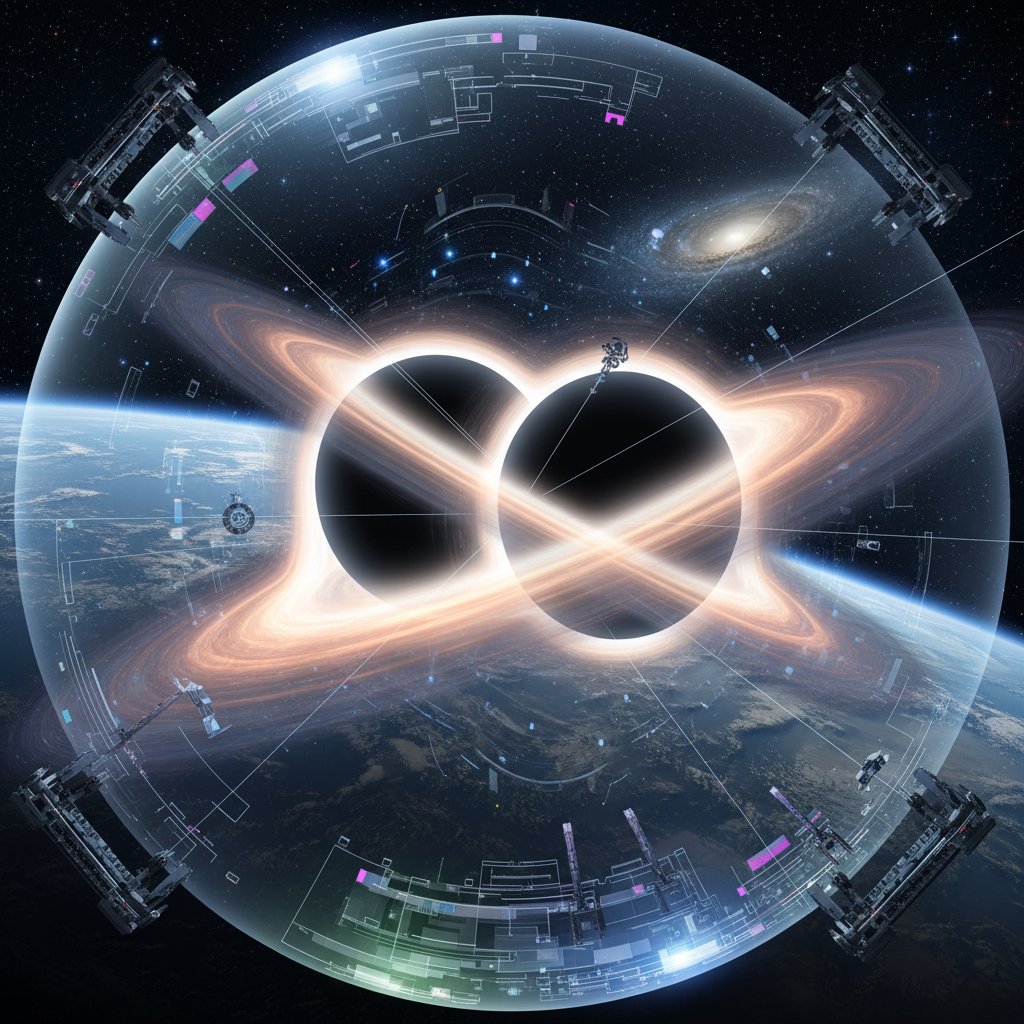
What does it look like when two supermassive black holes—each weighing billions of times the mass of our Sun—orbit each other in a cosmic dance? Until recently, astronomers could only infer such pairings through indirect hints like periodic light variations or gravitational ripples. But in 2022, a team led by Dr. Anne-Kathrin Baczko of the Max Planck Institute for Radio Astronomy achieved what no one had before: a direct radio image showing two distinct supermassive black holes locked in a binary system, coexisting in a single galaxy. This historic image, published in Astronomy & Astrophysics, is not just a stunning visual—it’s a new window into the violent heart of galaxy mergers and a crucial testbed for gravitational wave predictions.
A Cosmic Pair: 4.4 Billion Light-Years Away
The binary system, cataloged as 0402+379, resides in the galaxy cluster Abell 0476, some 4.4 billion light-years from Earth. At the center of that galaxy, two supermassive black holes orbit a common center of mass, separated by a mere 0.96 kiloparsecs (about 3,000 light-years). That sounds vast, but on cosmic scales it is like two marbles glued together on a billiard table. Their combined mass? A staggering 15 billion solar masses.
“We didn’t just see one source—we saw two compact radio cores, side by side,” said Dr. Baczko in a press release. “This is the first time we have taken a direct image of two supermassive black holes together.” The image, produced by the Very Long Baseline Array (VLBA)—a network of ten radio dishes scattered across the United States—reveals both black holes as brilliant points of radio emission, with a faint bridge of material connecting them. That bridge is likely gas stripped from the galaxy’s core as the pair spirals inexorably inward.
“This is the highest-resolution image ever obtained of a supermassive black hole binary,” said Dr. Baczko. “It shows us that these two giants are still distinct, not yet merged, and very much active.”
How They Captured the Unseen: VLBA’s Super-Sharp Eye
Supermassive black holes themselves are invisible—their gravity traps even light. But the regions around them, where material is heated to millions of degrees as it spirals into the maw, shine brightly across the electromagnetic spectrum. For 0402+379, the emission at radio wavelengths is particularly strong, thanks to relativistic jets launched from the vicinity of each black hole.
The team used the VLBA at a wavelength of 3.5 cm—a frequency where Earth’s atmosphere is nearly transparent. By combining signals from telescopes spread over 8,000 kilometers, the VLBA achieves an angular resolution of about 0.3 milliarcseconds. That’s equivalent to reading a newspaper headline from a distance of 4,000 miles. At the distance of 0402+379, such resolution can separate objects barely 40 light-years apart—easily enough to distinguish two black holes 3,000 light-years apart.
But even with such power, capturing the pair took years of painstaking analysis. Observations from 2015 to 2019 were combined, and the team used advanced imaging algorithms to tease out the faint signals from background noise. The result is a crisp radio map showing two distinct cores, each with its own jet structure, surrounded by diffuse emission.
What This Means for Gravitational Wave Astronomy
Binary supermassive black holes are the ultimate cosmic engines. When they eventually merge—on timescales of millions of years—they will release gravitational waves far more powerful than those detected from stellar-mass black hole mergers. Current gravitational wave observatories like LIGO and Virgo cannot hear such low-frequency waves; instead, future space-based observatories like the Laser Interferometer Space Antenna (LISA), scheduled for launch in the 2030s, will tune into that frequency band.
“The existence of a binary like 0402+379 tells us that supermassive black hole binaries can persist for long periods before they finally coalesce,” says Dr. Christopher Reynolds, a theoretical astrophysicist at the University of Maryland who was not involved in the study. “That’s exactly the kind of system LISA is designed to detect—and now we have a direct image of one, which can help calibrate our models of how such binaries evolve.”
The separation of 0.96 kiloparsecs is still too wide for gravitational wave emission to be detectable by LISA; the black holes need to be much closer, within a few hundredths of a parsec. But the image provides the first solid measurement of the binary’s orbital parameters, including the mass ratio and the orientation of the jets. These data will feed into simulations of how the system is losing energy and inspiraling.
The Road Ahead: Watching the Dance
One of the most tantalizing prospects is to watch 0402+379 over the next decades to see if the two black holes are measurably moving closer. Currently, their orbital period is estimated to be around 24,000 years—far too long for human observation. But if the pair is surrounded by a dense gas disk, dynamical friction could speed up the inspiral. Repeated VLBA observations, along with future instruments like the Square Kilometre Array (SKA), may detect changes spanning decades.
“We are at the very beginning of directly studying binary supermassive black holes,” says Dr. Baczko. “This image is proof that they exist and that we can see them. The next step is to find more, and to understand their role in galaxy evolution.”
Other candidates have been spotted before, but always as unresolved sources or through indirect signatures like periodic variability. The breakthrough with 0402+379 comes because the two black holes are still relatively far apart and both are actively accreting gas, making them bright in radio. In other merging galaxies, one black hole might be dormant, or the pair might be too close to separate even with the VLBA.
For the reader—whether a curious stargazer or a student dreaming of astrophysics—the image of two supermassive black holes together is a reminder that the universe’s most extreme objects are not isolated, but social. They interact, merge, and shape the galaxies around them. In fact, many, if not most, large galaxies have likely experienced a merger at some point, birthing a binary black hole at their core. Our own Milky Way will eventually merge with Andromeda in about 4.5 billion years, and the supermassive black holes at their centers (Sagittarius A* and a likely counterpart) will one day circle and combine. This ancient dance, now imaged for the first time, is a preview of our own cosmic fate.
As the VLBA and future telescopes sharpen their view, astronomers will compile an album of such binary systems, charting their orbital decay and testing Einstein’s general relativity in the most extreme environments imaginable. The first photo of two black holes together is not a final destination—it is a starting point for a new chapter in observational astronomy.