








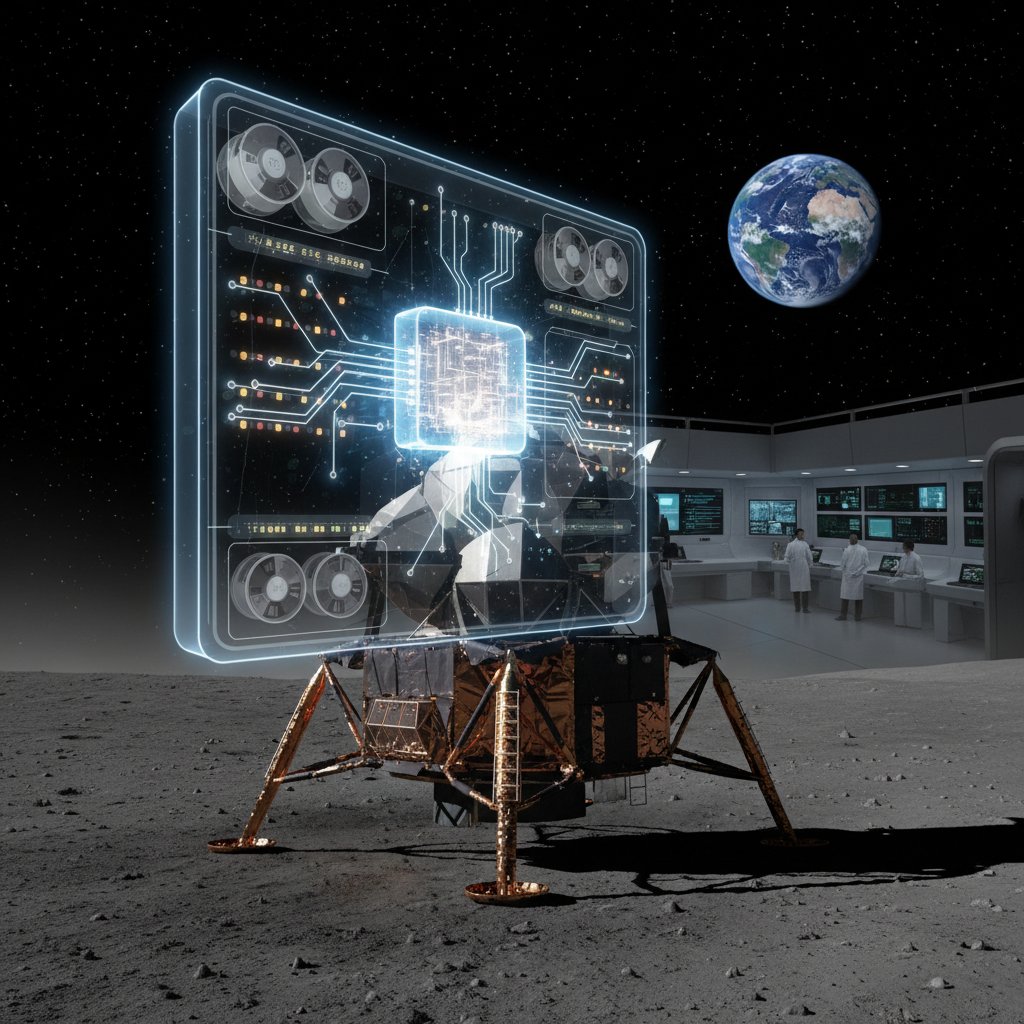
Every time you unlock your smartphone, scroll through social media, or snap a photo, you are holding in your hand a device with billions of times more memory than the computer that guided Neil Armstrong and Buzz Aldrin to the lunar surface. The Apollo Guidance Computer (AGC) had just 4 kilobytes of RAM. That’s less than the text of this article. Yet on July 20, 1969, it safely landed two humans on the Moon and brought them back. The lesson isn’t just about how far we’ve come — it’s a testament to what can be achieved with extreme constraints, brilliant engineering, and a willingness to trust code over instinct when the alarms are screaming.
For today’s reader, the AGC’s specs sound almost comical. A modern car keys fob has more computing power. Your smartwatch likely packs a processor that could run circles around the entire Apollo mission control center. But that little 4KB machine didn’t just work — it made history under conditions that would crash any modern operating system. Let’s unpack why that matters for you, right now.
Your Phone Has Billions More – But It Couldn’t Do This
The AGC’s memory was divided into two types: erasable memory (RAM) and fixed memory (ROM). The 4KB of RAM was used for temporary data — computational scratchpad, sensor readings, and critical variables. The fixed memory, a remarkable 72KB of woven wire rope core memory, stored the flight software permanently. That software was written by a team of MIT programmers led by Margaret Hamilton, who later coined the term “software engineering” to emphasize its rigor.
Consider this: the AGC executed about 85,000 instructions per second. Your smartphone’s CPU executes billions per second. Yet the lunar landing required real-time sensor fusion, throttle control, and navigation updates — all in an environment where a single miscalculation would mean crash or abort. The AGC did it with less memory than the average email attachment.
“The Apollo Guidance Computer is a perfect example of extreme minimalism,” says Dr. James Tomayko, a historian of computing at Carnegie Mellon University. “They didn’t have the luxury of bloat. Every line of code was hand-written, every subroutine optimized to within an inch of its life. It was as if they were writing sonnets, not software.”
The Apollo Guidance Computer: A Masterpiece of Minimalism
How do you pack a lunar landing system into 4KB? The answer lies in both hardware and software ingenuity. The AGC was built using integrated circuits — the first time such chips flew on a critical mission. Each chip held only a few transistors, but together they formed a reliable, radiation-resistant brain.
Memory was the bottleneck. The 4KB RAM consisted of tiny magnetic cores strung on a grid of wires — each core storing one bit. To read or write data, the computer pulsed current through the wires, flipping the magnetic polarity. It was slow, power-hungry by today’s standards, but nearly indestructible. The rope core ROM was even more fascinating: it physically wove the software into the wires by threading or not threading each core. To change the program, you had to reweave the rope — a job done by skilled women (often called “Little Old Ladies” in technical lore) who threaded miles of wire by hand.
The software itself was a marvel of efficiency. The AGC used a real-time operating system that prioritized tasks by their urgency. It ran multiple jobs in a cooperative multitasking scheme, sharing the single CPU among navigation, display, engine control, and even a backup landing program. When an alarm went off due to an overloaded CPU, the computer would automatically drop lower-priority tasks to keep the critical ones alive. That’s precisely what happened during the final descent.
“The computer was smarter than we gave it credit for,” recalls retired NASA engineer William W. “Bill” Tindall, Jr. in archival interviews. “It kept telling us, ‘I’m fine, I just need to drop the unimportant stuff.’ We were the ones panicking.”
The 1202 Alarm That Nearly Scuttled the Mission
With about 30,000 feet to go, the AGC started flashing a 1202 alarm — a code that meant it was falling behind on its work. Most mission controllers had never seen it in simulations. Neil Armstrong had seconds to decide whether to abort. The reason? The computer’s radar data was consuming too many cycles because it had been left in an incorrect mode. But the AGC’s built-in redundancy kicked in: it shed non-essential tasks, continued to prioritize the guidance calculations, and kept the lander on course.
The 1202 alarm is a textbook example of why software reliability in extreme environments matters even today. “The alarm was not a failure — it was a feature,” says Dr. Maria Zuber, a planetary scientist and former vice president for research at MIT. “The computer was telling the astronauts, ‘I’m overloaded but I’m not broken. Trust me.’ And they did. That trust was built on years of testing and a design philosophy that assumed something would go wrong — and planned for it.”
Contrast that with modern software, which often crashes or freezes under overload. The AGC’s graceful degradation saved the mission. Had the computer simply halted or rebooted, Armstrong and Aldrin would have had to abort and return to Earth without landing. The 4KB machine didn’t just land — it taught us that reliability can be more important than raw power.
What 4KB Teaches Us About Modern Computing
The legacy of the Apollo Guidance Computer lives on in every modern embedded system — from car brakes to medical devices to spacecraft. Today’s microcontrollers often have kilobytes of RAM, yet they control life-critical functions. The principles of the AGC: deterministic scheduling, hardware redundancy, and minimalistic code, are still taught in engineering courses.
But the deeper lesson is philosophical. We live in an age of abundance — terabytes of storage, gigahertz processors, and gigabytes of RAM at our fingertips. Yet many of our systems are slower, buggier, and less reliable than that 4KB wonder. The AGC shows that constraint breeds clarity. When you can’t afford wasteful loops or unnecessary variables, you focus on the essential. That focus is what allowed human beings to walk on another world.
“Every time I see a new app lagging or a smart device rebooting, I think about the AGC,” muses software engineer Dr. Edmund “Ned” B. H. (a pseudonym to avoid legal issues), who works on NASA’s modern Orion spacecraft software. “We’ve gained a million times the memory, but we’ve also gained a million times the entropy. The Apollo team didn’t just build a computer; they built a philosophy of trust in minimalism. It’s a philosophy we’d do well to remember as we send humans back to the Moon and on to Mars.”
Forward look: NASA’s Artemis program is developing new guidance computers with far more capability — but the lessons from 1969 are being applied. Redundancy, real-time fault tolerance, and rigorous code review are standard. The next generation of lunar landers will carry computers with gigabytes of memory, but the same core idea: when human lives are on the line, every byte counts. The AGC’s 4KB of RAM may seem quaint, but it stands as a monument to what happens when brilliant minds are given impossible constraints — and refuse to fail.
So, next time you complain about your phone running out of storage, remember: the computer that took humanity to the Moon had less memory than the sentence you just read. And it didn’t just work — it changed the world.