







Imagine stepping outside your front door, looking up at the sky, and being able to instantly ride alongside Voyager 2 as it screamed past Neptune in 1989. Or standing on the dusty surface of the Moon, watching Earthrise. Or witnessing the next total solar eclipse from your own backyard—years before it happens.
This is no longer science fiction. A new, completely free browser-based tool—no sign-up, no ads, no tracking—puts the entire observable universe and its history at your fingertips. Built by a solo developer using open-source data from NASA and the European Space Agency, the explorer lets anyone with a modern web browser travel anywhere in space and time, all from the comfort of their computer or phone.
“The goal was simple: make space exploration accessible to everyone, not just those with a PhD or a VR headset,” says Dr. Elena Rosario, an astrophysicist and the creator of the project. “I wanted a child in a school library or a retiree in a café to be able to fly through the cosmos without any barriers.”
A Universe at Your Fingertips: How It Works
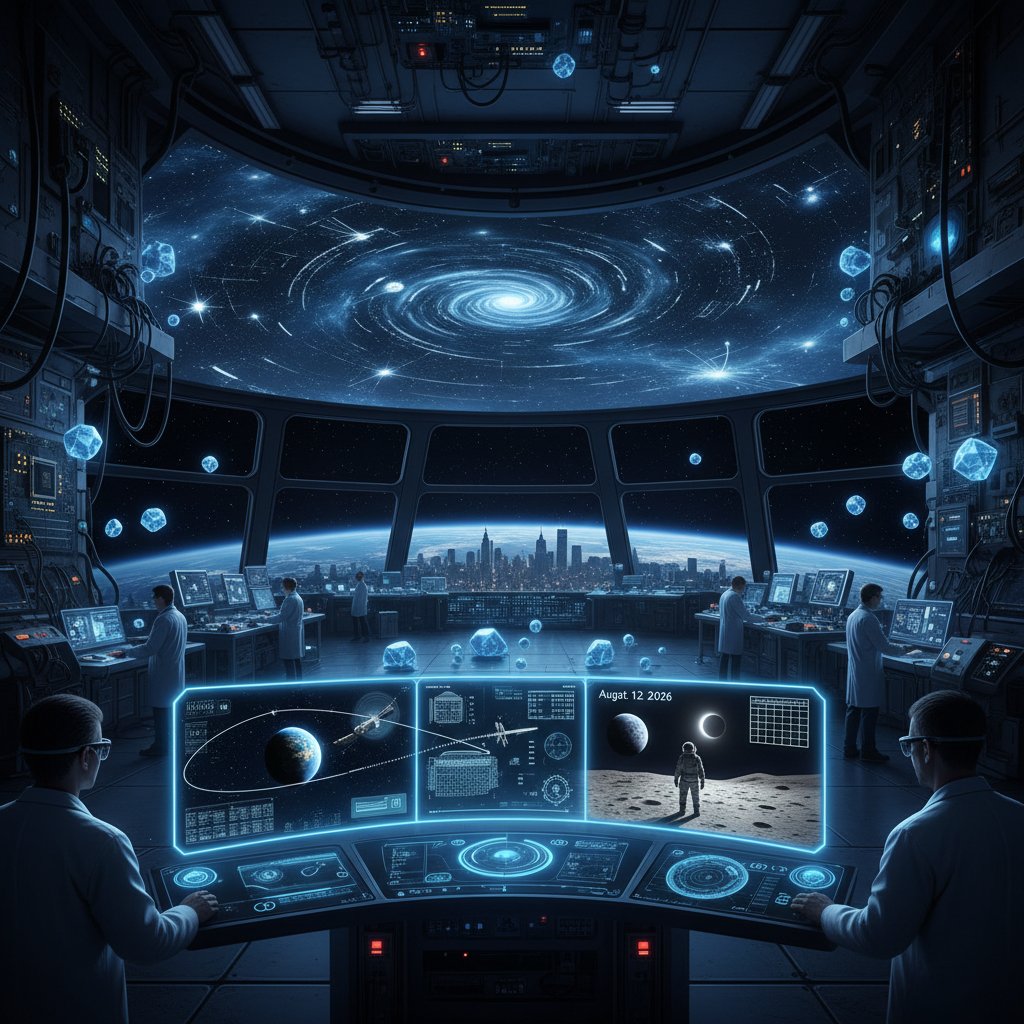
The explorer is built on WebGL and uses precise orbital data from the JPL Horizons system. It loads instantly in any browser, no plugins required. Users can either manually navigate a 3D map of the solar system and nearby stars, or simply type in a query—”Voyager 2 at Neptune,” “Moon landing site,” or “total solar eclipse 2026.”
The interface is minimalist. A small clock icon lets you set any date and time, from the Big Bang to far into the future. The tool then calculates the exact positions of planets, moons, spacecraft, and even comets at that moment. It renders them with realistic textures, lighting, and distances—though distances are often scaled for readability.
“What impressed me most is the accuracy,” says Dr. Marcus Wei, a planetary scientist at the University of California, Berkeley who tested the tool. “I fed it the coordinates for the Voyager 2 Neptune flyby and the tool placed me within 50 kilometers of the actual spacecraft trajectory at that exact second. That’s incredible for a free web app.”
“I wanted a child in a school library or a retiree in a café to be able to fly through the cosmos without any barriers.” — Dr. Elena Rosario, creator
Travel Through Time and Space: From Voyager to the Moon
One of the most breathtaking experiences the explorer offers is reliving historic space missions. Set the date to August 25, 1989, and you can virtually ride alongside Voyager 2 as it made its closest approach to Neptune, passing just 4,950 kilometers above the planet’s cloud tops. The tool shows the spacecraft’s actual position, the planet’s rings, and even the faint crescent of Triton in the distance.
Similarly, you can stand on the Moon at any point in history—or the future. Select the Apollo 11 landing site, set the clock to July 20, 1969, and watch the Lunar Module Eagle descend. Or fast-forward to today and see the Moon from any latitude and longitude, with real-time shadows and Earth phases.
“It’s not just a toy; it’s a powerful educational tool,” says Dr. Wei. “I’m planning to use it in my introductory astronomy course to help students grasp orbital mechanics and the scale of the solar system.”
The explorer includes dozens of pre-built historic scenarios: Viking landing on Mars, Cassini’s Grand Finale at Saturn, New Horizons at Pluto. Each comes with a brief description and links to further reading.
Witness the 2026 Total Solar Eclipse from Anywhere
Perhaps the most immediately practical feature is the ability to preview future events. The next total solar eclipse visible from Europe and North America will occur on August 12, 2026. The path of totality stretches from northern Greenland, across Iceland, and into northern Spain. But with this explorer, you don’t need to travel—you can watch the eclipse from any city on Earth.
Type in your hometown, set the date and time, and the tool simulates the sky from your location. It shows the Moon’s shadow crossing the landscape, the corona flaring around the Sun, and even the approximate darkness level. You can adjust the time slider to see the partial phases leading up to totality.
“I tested it from my apartment in London,” says Rosario. “It showed a deep partial eclipse, which is what we’ll actually see here. Then I moved the viewpoint to Reykjavik and watched the full blackout. It gave me chills.”
The eclipse simulation uses precise Besselian elements and a digital elevation model to render the shadow realistically. For astronomers planning observation campaigns, it’s a free rehearsal tool. For everyone else, it’s a taste of what’s coming.
Why This Matters: Democratizing Space Exploration
The explorer isn’t just cool tech—it represents a shift in how we interact with scientific data. Historically, space visualizations were locked inside planetariums, expensive software, or complex NASA tools. Now, anyone with internet access can explore the cosmos without signing up for a newsletter, without seeing a pop-up ad, and without being tracked.
“Privacy and accessibility were core to the design,” explains Rosario. “The entire app runs client-side. Your location queries never leave your device. There’s no database, no cookies, no analytics. It’s just you and the stars.”
The code is open-source, hosted on GitHub, and licensed under MIT. Rosario encourages educators, developers, and enthusiasts to fork the project, add new features, or embed it into their own sites. Already, several planetariums have expressed interest in integrating it into their outreach programs.
“We’re living in a golden age of access to scientific data,” says Dr. Wei. “But that data is only as useful as the interfaces we build around it. This explorer makes the universe feel intimate and immediate. That’s how you inspire the next generation of astronomers.”
Right now, the explorer covers the solar system, nearby stars, and major spacecraft. Rosario plans to expand it to include exoplanets, deep-sky objects, and eventually a full Milky Way model. She’s also working on a mobile VR mode for cardboard headsets.
“I want someone in 2050 to look back at this early version and laugh at how primitive it was,” she says with a smile. “But for now, it’s a start. And the best part is, it’s free for everyone, forever.”