






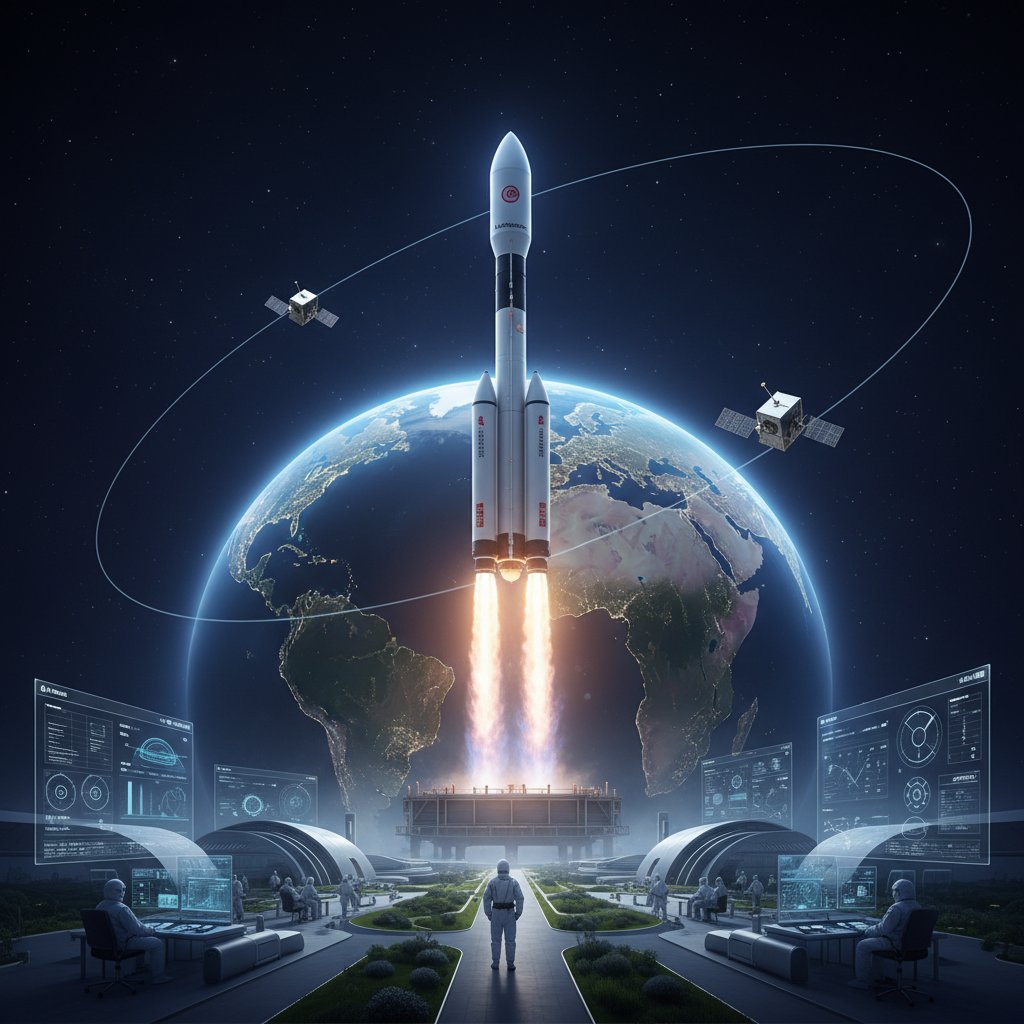
What does it take for a methane-fueled rocket to shift from experimental curiosity to commercial workhorse? On Tuesday, China’s LandSpace provided a compelling answer. The company’s Zhuque-2E Y6 rocket lifted off from the Jiuquan Satellite Launch Center in the Gobi Desert at 9:22 a.m. Beijing time, carrying two satellites into low Earth orbit. The mission marks another milestone for methane propulsion, a technology that promises cleaner, more cost-effective space access.
The Zhuque-2E is an upgraded variant of LandSpace’s Zhuque-2, the world’s first methane-liquid oxygen rocket to reach orbit in July 2023. Tuesday’s launch was the sixth flight of the Zhuque-2 series and the first for the enhanced ‘E’ model, which features an improved payload capacity of up to 4 metric tons to low Earth orbit. The two satellites, whose identities and purposes have not been fully disclosed by LandSpace, were successfully deployed approximately 10 minutes after liftoff.
Why Methane Matters
Methane propulsion is not new to the space industry, but it has gained momentum in recent years as a ‘green’ alternative to traditional kerosene-based fuels. Methane burns more cleanly, producing less soot and carbon buildup in engines, which simplifies reuse. It also offers higher specific impulse—a measure of fuel efficiency—than kerosene, though less than hydrogen. Crucially, methane can be produced on Mars using local resources, making it a favorite for future interplanetary missions.
“Methane is the sweet spot for reusable rockets,” says Dr. Sarah Kim, a propulsion engineer at the University of Colorado Boulder. “It combines the storability of kerosene with the performance of hydrogen, and it’s much easier to handle. This launch shows that China is serious about commercializing that technology.”
SpaceX’s Raptor engine and Blue Origin’s BE-4 also use methane, but LandSpace’s achievements are significant because they demonstrate that a private Chinese company can compete in this arena. The Zhuque-2E Y6 flight builds on a track record: after a failed first attempt in December 2022, LandSpace succeeded on its second try in July 2023, becoming the first to orbit a methane rocket. Subsequent launches in December 2023, September 2024, and November 2024 refined the design.
Commercial Ambitions and National Strategy
LandSpace, founded in 2015, is part of China’s burgeoning private space sector, which has grown under supportive government policies. The company aims to offer dedicated rideshare missions and dedicated launches for small satellites, a market dominated by SpaceX’s Falcon 9 and Rocket Lab’s Electron. With the Zhuque-2E, LandSpace targets a price point of around $10,000 per kilogram to low Earth orbit, comparable to Falcon 9’s pricing.
Tuesday’s launch also carries strategic weight. China’s space program, both state-run and private, is accelerating as the country seeks to establish its own satellite constellations for communications, Earth observation, and navigation. The Zhuque-2E Y6 payloads are believed to include a technology demonstration satellite for a future broadband network, though LandSpace has not confirmed this.
“This is a clear signal that China’s private launchers are maturing,” says Dr. Wei Chen, an aerospace analyst at the China Institute of Space Law. “The Zhuque-2E’s success narrows the gap between Chinese and Western commercial launch capabilities. We can expect more frequent flights and larger payloads in the coming years.”
The launch also coincided with an international space conference in Beijing, where LandSpace executives promoted the rocket’s reliability. The company has announced plans for up to 10 launches in 2025, including missions for international customers.
What This Means for the Reader
For the average person, the rise of methane rockets might seem esoteric, but its implications are tangible. Cheaper launches mean lower costs for satellite-based services like internet, GPS, and weather forecasting. They also enable more scientific missions, from Earth observation to deep-space probes. Reusable methane rockets could eventually slash launch costs by an order of magnitude, making space more accessible to universities, startups, and developing nations.
Moreover, the environmental benefits are not trivial. Traditional kerosene rockets release black carbon and other pollutants into the upper atmosphere. Methane combustion produces primarily water vapor and carbon dioxide, with less particulate matter. While still a fossil fuel, methane’s cleaner burn reduces the space industry’s carbon footprint, a growing concern as launch rates increase.
Yet challenges remain. Methane is a potent greenhouse gas if leaked, and its production must be managed carefully. LandSpace’s rockets are not yet fully reusable, though the company is developing a reusable first stage. The Zhuque-2E uses an expendable design, but future variants aim for vertical landing recovery.
Looking Ahead
The Zhuque-2E Y6 launch is a stepping stone, not a destination. LandSpace is already testing components for the Zhuque-3, a larger, fully reusable rocket that could rival SpaceX’s Starship in payload capacity. If successful, it would position China as a major player in heavy-lift launch services. Meanwhile, competitors like Galactic Energy and iSpace are also advancing their own methane engines.
As the global space race heats up, Tuesday’s flight reminds us that innovation often comes from unexpected quarters. For LandSpace, the question is no longer whether methane works, but how fast they can scale it. For the rest of us, the sky is getting cheaper—and that changes everything.