







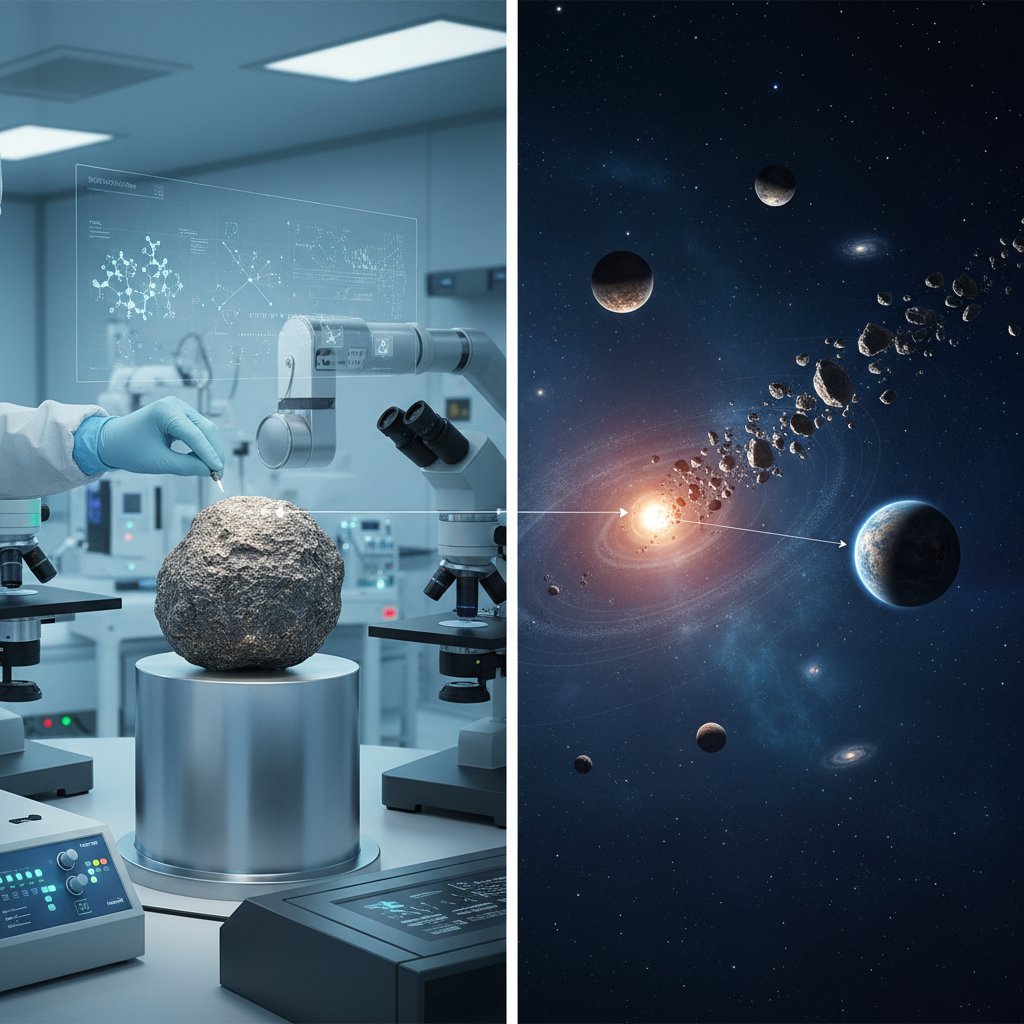
Could a humble rock from the Sahara desert be a message from a world that no longer exists? That is the provocative question raised by a team of planetary scientists analyzing a small meteorite discovered in southern Algeria in 2022. The sample, designated NWA 15925, appears to be the first known fragment of a long-destroyed planetesimal—a building block of the early solar system that never made it to full planet status.
If confirmed, the find would rewrite our understanding of how planets form, offering a direct glimpse into a class of celestial bodies that have until now been purely theoretical. The study, published this week in Nature Communications, has sent ripples through the meteoritics community.
The Discovery That Shook Planetary Science
The story begins in the vast, arid expanse of the Ténéré desert, a region known for yielding some of the most primitive meteorites on Earth. A nomadic guide noticed the dark, smooth stone half-buried in sand, its fusion crust still intact. He handed it over to the Geological Survey of Algeria, who shipped a 32-gram slice to the University of Chicago for analysis.
What the researchers found was baffling. The meteorite is an achondrite—a type of rock that formed from molten magma, indicating its parent body once underwent differentiation, separating into crust, mantle, and core. But its oxygen isotope ratios fell completely outside the known groups for any existing asteroid or planet.
“We immediately knew we had something special,” says Dr. Sarah Chen, lead author of the study and a research scientist at the University of Chicago. “The isotopic fingerprint didn’t match anything in our databases—not Vesta, not Mars, not the Moon. It was like finding a signature from a ghost.”
Further tests using noble gas isotopes and trace element analysis confirmed that NWA 15925 crystallised about 4.57 billion years ago, within the first 5 million years of the solar system’s formation. That timing places it squarely in the era when dozens of protoplanets were competing for mass, only to be smashed apart by giant impacts.
The Signature of a Lost World
So what exactly makes NWA 15925 so alien? The key lies in its oxygen isotope ratios. Every body in the solar system has a unique triple-oxygen isotope signature, inherited from the region of the protoplanetary disk where it formed. The ratios for NWA 15925 plot in a previously empty zone, representing a distinct reservoir of material.
“It’s as if we found a dialect of an unknown language,” explains Dr. Mark Lee, a planetary geologist at the Natural History Museum in London who was not involved in the study. “The rock tells us that a small, differentiated world existed in the inner solar system—probably between Mercury and Mars—and was later destroyed. We’ve never seen a piece of such a world before.”
The meteorite itself is a kind of pyroxenite, rich in orthopyroxene and with a coarse-grained texture that suggests it cooled slowly deep within a crustal magma chamber. That implies the parent body was at least several hundred kilometers in diameter, large enough to sustain prolonged volcanic activity.
What Was This Lost World?
In the early solar system, the region inside the asteroid belt was crowded with dozens of Mars-sized to Moon-sized protoplanets. Most were shattered by collisions, and their debris either fell into the Sun, accreted onto the growing terrestrial planets, or was scattered into the asteroid belt. The surviving fragments are rare. Until now, all known achondrites came from a handful of parent bodies: the asteroid Vesta, the Moon, Mars, and a few small differentiated asteroids like the angrite parent body.
NWA 15925 does not fit any of these categories. Its mineralogy and isotopic composition are unique, suggesting a separate, previously unknown parent body that formed and differentiated early, then was catastrophically disrupted before the Late Heavy Bombardment began 4.1 billion years ago.
“This is our first tangible link to a whole class of early planets that were the building blocks of the inner solar system,” says Dr. Chen. “We call them ‘lost worlds’ because they no longer exist intact. But their fragments are still out there, waiting to be found.”
The implications are profound. Computer models of planet formation predict that tens of such protoplanets existed, but direct evidence has been lacking. NWA 15925 provides a window into the composition, geological history, and formation timescale of one of those objects.
Why This Matters for Earth’s Story
Understanding these lost worlds isn’t just a cosmic curiosity. Earth’s composition shows strong isotopic similarities to a class of meteorites called enstatite chondrites, but also contains a mix of volatile elements that hint at contributions from multiple parent bodies. The discovery of NWA 15925 suggests that the feeding zone of the terrestrial planets was far more diverse than previously thought.
“Every time we find a new type of meteorite, it’s like adding a new ingredient to the recipe that built Earth,” notes Dr. Lee. “We now have evidence for a distinct flavor of planetesimal that we didn’t know existed. That changes how we model the growth of our own planet.”
The meteorite also contains tiny inclusions of calcium-aluminium-rich inclusions (CAIs) and chondrules, dating back to the very birth of the solar system. These components are similar to those found in primitive chondrites, suggesting that the lost world incorporated unprocessed dust and gas from the solar nebula into its interior during differentiation.
The Hunt for More Fragments
The Sahara is already the most productive terrestrial hunting ground for meteorites, yielding thousands of specimens each year. But most are ordinary chondrites—common asteroid fragments. NWA 15925 demonstrates that rare, scientifically invaluable pieces of lost worlds are still out there, hidden in the sand.
“Finding just one such meteorite means there must be more,” says Dr. Chen. “We are now systematically scanning the isotopic signatures of every unusual achondrite in our collections. I suspect this is the tip of the iceberg.”
Planned space missions, including NASA’s Psyche and Japan’s Martian Moons eXploration (MMX), will provide context by probing the crusts of similar differentiated bodies. But meteorites like NWA 15925 offer something no spacecraft can: a rock from a world that no longer exists.
“Every piece of a lost world is a Rosetta Stone,” concludes Dr. Lee. “It tells us about a time we can never visit. And now we finally have one in our hands.”