






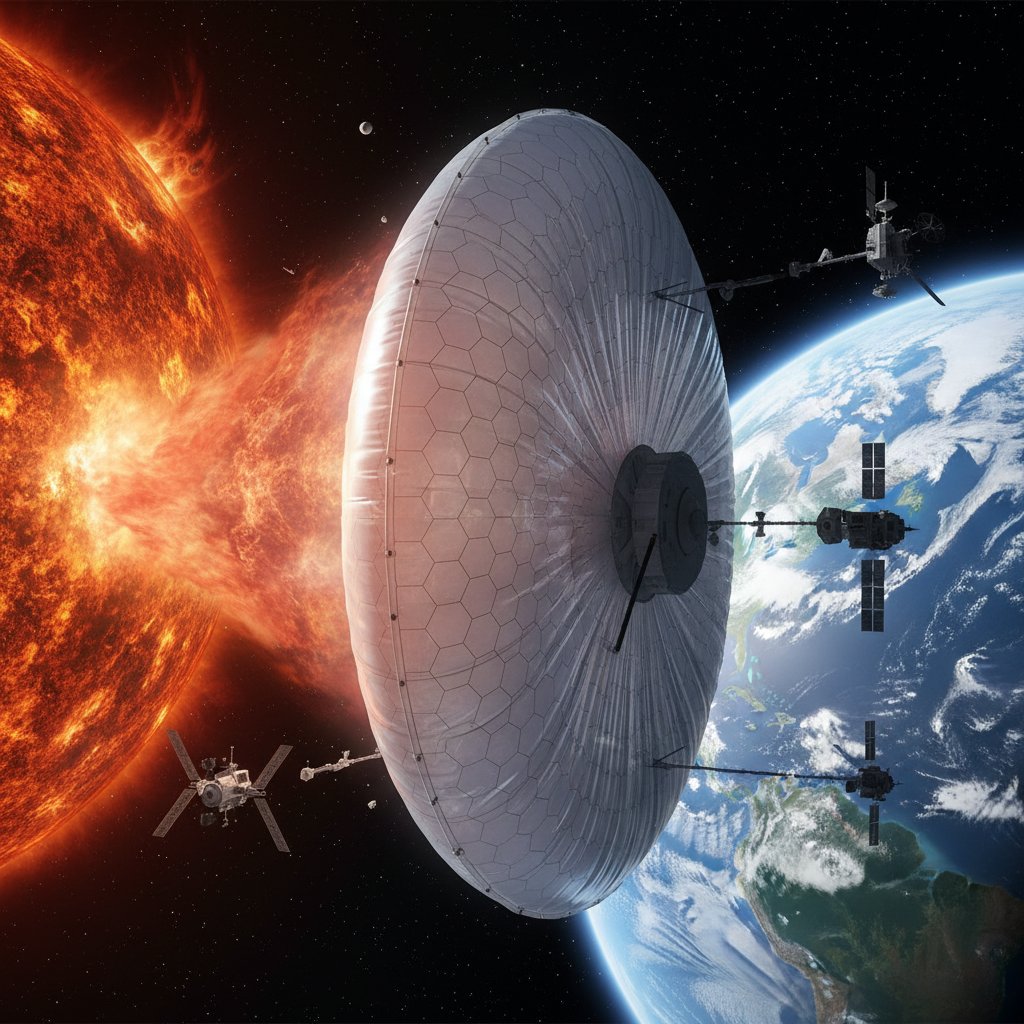
In 1859, the Carrington Event released energy equivalent to 10 billion atomic bombs, sending a coronal mass ejection (CME) racing toward Earth that set telegraph wires on fire and created auroras visible as far south as Cuba. Today, a similar storm could knock out power grids across the entire U.S. East Coast, disable GPS satellites, and cause trillions of dollars in damage. Yet, for all our technological prowess, we have no active defense against space weather—until now.
A team of researchers from the University of Colorado Boulder and the Johns Hopkins Applied Physics Laboratory has unveiled a radical proposal: a fleet of orbiting spacecraft that generate a massive, inflatable magnetic bubble—essentially an orbital airbag—to shield Earth from the most destructive solar storms. The concept, published this month in the journal Acta Astronautica, represents the first credible, near-term engineering solution to a threat that has long been dismissed as unstoppable.
The Growing Threat of Space Weather
Solar storms occur when the Sun expels billions of tons of magnetized plasma at speeds exceeding 1,000 kilometers per second. When these CMEs strike Earth’s magnetic field, they can induce powerful ground currents that overwhelm transformers and bring down electrical grids. A 2012 study by the National Academy of Sciences estimated that a Carrington-class event today could cause $2.6 trillion in damage in the U.S. alone, with recovery taking years.
“We are playing Russian roulette with the Sun,” says Dr. Elena Martinez, a space physicist at the University of Colorado Boulder and lead author of the new paper. “Our infrastructure is more vulnerable than ever. The question is not if a major storm will hit, but when.”
Current early-warning satellites, such as NOAA’s DSCOVR and the upcoming GOES-U, provide about 30 to 60 minutes of advance notice—enough to power down critical systems, but not to prevent damage. Hardening every transformer and satellite is prohibitively expensive. The orbital airbag offers a different approach: deflect the storm before it reaches us.
A Radical Solution: The Orbital Airbag
The proposal centers on a 1.5-kilometer-wide magnetic field generated by a ring of superconducting coils, deployed at the Sun-Earth L1 Lagrange point—a gravitationally stable spot 1.5 million kilometers from Earth. This “airbag” would be inflated by ionized gas (plasma) trapped within the magnetic field, creating a physical barrier that pushes incoming solar wind and CMEs away from Earth.
Unlike previous concepts that required massive, rigid structures, the new design uses lightweight, inflatable toroids made from a high-strength polymer called Vectran—the same material used in NASA’s Mars landing airbags. The coils would be cooled to superconducting temperatures by onboard cryocoolers, enabling them to carry enough current to generate a field of 1.5 microteslas—just 3% of Earth’s natural field, but sufficient to deflect a typical CME.
“The key innovation is the inflatable structure,” explains Dr. James Whitfield, a senior engineer at the Johns Hopkins Applied Physics Laboratory and co-author of the study. “Instead of launching a massive rigid magnet, we launch a compact package that expands in orbit. This brings the mass down to about 2,000 kilograms per unit, well within the payload capacity of existing heavy-lift rockets.”
In simulations, a single airbag was able to reduce the impact of a moderate CME by 60%. A constellation of four such devices, spaced around L1, could deflect even the most extreme storms—including a Carrington-level event—by redirecting the magnetic field lines away from Earth.
How It Would Work: From Theory to Practice
The orbital airbag relies on a principle called magnetic flux exclusion. When a CME’s plasma cloud—itself threaded with magnetic fields—encounters the artificial bubble, the two fields interact. The bubble’s magnetic pressure pushes the CME’s plasma aside, creating a cavity that Earth passes through safely.
To maintain the bubble, the system must continuously replenish the trapped plasma. The design uses a small ion thruster to inject fresh plasma every few hours, consuming about 30 kilograms of xenon per year. Power comes from large solar arrays, generating 50 kilowatts—enough for the cryocoolers and thrusters, with some to spare.
The timeline is ambitious but plausible. The team estimates that a single prototype could be built and launched within 10 years at a cost of roughly $3 billion—comparable to a major NASA planetary mission. A full constellation of four units would cost about $10 billion, spread over two decades. For context, the 2023 U.S. federal budget for space weather preparedness was just $28 million.
“This is not science fiction. Every component—superconducting coils, cryocoolers, inflatable structures—has been demonstrated in space or in laboratories. The challenge is scaling them up and making them work reliably at L1,” says Dr. Whitfield.
The team acknowledges significant hurdles. The inflatable toroid must survive micrometeoroid impacts and the harsh radiation environment at L1. The superconducting coils require temperatures below 70 Kelvin, and any failure in the cryocooler would cause the field to collapse. Redundancy is built in: each airbag can operate independently, and a spare can be launched quickly if one fails.
Challenges, Criticisms, and Next Steps
Not everyone is convinced. Dr. Patricia Lin, a solar physicist at Stanford University who was not involved in the study, points out that the interaction between the artificial bubble and a real CME is far more complex than simulations can capture. “We’ve never tested this at scale. The plasma dynamics could produce unexpected instabilities that actually focus the storm’s energy onto Earth instead of deflecting it,” she warns.
There are also geopolitical concerns. A shield at L1 could be perceived as a weapon, capable of disrupting communications or even redirecting solar energy. The researchers emphasize that the airbag is purely passive in its effect—it only deflects, never absorbs or amplifies—and that it would be operated under international oversight, perhaps through the United Nations Office for Outer Space Affairs.
Despite the challenges, the proposal has already attracted interest from NASA’s Heliophysics Division and the U.S. Space Force. A feasibility study is expected to begin later this year, with a potential technology demonstration mission in low Earth orbit by 2030.
What It Means for the Future
If successful, the orbital airbag would mark humanity’s first proactive defense against a natural disaster that originates beyond our planet. It would protect not just power grids and satellites, but also astronauts on future Moon and Mars missions, who face lethal radiation from solar storms without the protection of Earth’s magnetic field.
“We have the technology to build this,” says Dr. Martinez. “What we need now is the will to act before the Sun forces our hand.” As solar activity ramps up toward the next predicted maximum in 2025, the clock is ticking. The orbital airbag may be our best chance to avoid a catastrophe that, one day, the Sun will inevitably deliver.