







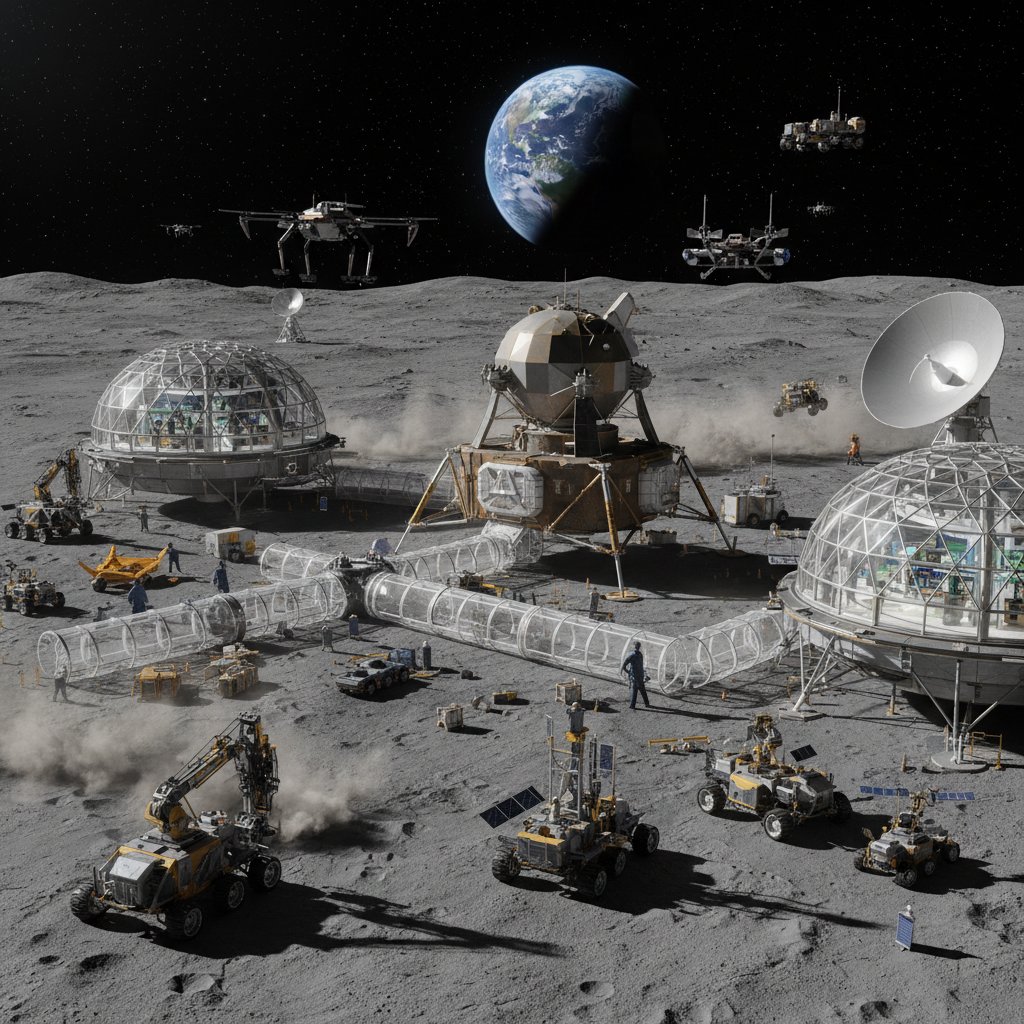
How will NASA build a permanent base on the Moon? The answer is taking shape with a fleet of rovers, landers, and drones that are turning science fiction into engineering reality. For the first time in over half a century, humanity is not just visiting the lunar surface—we are preparing to stay.
Under the Artemis program, NASA aims to establish a sustainable outpost near the Moon’s south pole by the late 2020s. This isn’t a single structure; it’s a sprawling network of habitats, power stations, and mobility systems. The key enablers? Rugged rovers, precision landers, and autonomous drones. Together, they form the backbone of what could become our first off-world colony.
Rovers: The Lunar Workhorses
Rovers have come a long way since the Apollo-era Lunar Roving Vehicle, which was essentially a glorified golf cart. Today’s designs are autonomous, radiation-hardened, and built for years of continuous operation. NASA’s Volatiles Investigating Polar Exploration Rover (VIPER), scheduled to launch in late 2024, will hunt for water ice at the south pole. “VIPER is our prospector,” says Dr. Sarah Noble, NASA’s program scientist for lunar exploration. “It will tell us exactly where the water is, how much there is, and how accessible it is—critical data for any future base.”
But VIPER is just the beginning. The agency is also developing the Lunar Terrain Vehicle (LTV), a pressurized rover that can carry astronauts on multi-day treks across the surface. Unlike the open Apollo buggy, the LTV will have a cabin, life support, and even a robotic arm. Think of it as a mobile science lab and survival shelter rolled into one. “We’re not just driving around for fun,” explains Dr. James Chen, a rover systems engineer at NASA’s Johnson Space Center. “These rovers will scout construction sites, deliver supplies, and even assist in building habitats. They are the muscle of the lunar base.”
Private companies are also stepping up. Astrolab’s FLEX rover, designed to carry cargo and astronauts, recently secured a NASA contract. Meanwhile, Japan’s ispace is developing its own micro-rovers for soil analysis. The competition is fierce, and that’s good news for taxpayers. More players mean lower costs and faster innovation.
Landers: Precision Delivery to the Surface
Getting to the Moon is hard. Landing precisely where you want is even harder. But that’s exactly what NASA’s Commercial Lunar Payload Services (CLPS) program is achieving. Multiple landers from companies like Intuitive Machines, Astrobotic, and Firefly Aerospace are now delivering experiments and equipment to targeted sites near the south pole.
In February 2024, Intuitive Machines’ Odysseus lander made history as the first private spacecraft to touch down softly on the Moon. Although it tipped over, it still transmitted valuable data. “Each landing teaches us something,” says Dr. Maria Zuber, a planetary scientist at MIT. “We’re learning to navigate the treacherous terrain of the lunar south pole—boulders, craters, and shadows that haven’t seen sunlight in billions of years.”
These landers are not one-off missions. They are part of a supply chain that will eventually deliver habitat modules, power systems, and even a lunar railway. Blue Origin’s Blue Moon Mark 2 lander, selected for a crewed mission later this decade, can carry up to 30 metric tons—enough to land a fully equipped base module. “We’re building a trucking service to the Moon,” says John Couluris, Blue Origin’s senior vice president of lunar operations. “The lander is the truck; the base is the warehouse.”
The precision landing technology is also critical for safety. Future astronauts won’t want to hike miles from their landing site to the base. Landers must put them within walking distance—or better, within rover distance.
Drones: Eyes in the Sky and Beyond
While rovers crawl and landers thump down, drones will take to the thin lunar sky. Yes, flying on the Moon is possible—the lack of atmosphere means you need rocket thrusters instead of wings, but the concept is the same. NASA’s Dragonfly mission to Titan has paved the way, and now lunar drones are being developed for reconnaissance and sample collection.
The most ambitious is the Lunar Reconnaissance Orbiter (LRO) successor, but closer to the surface, small quadcopter-like drones using cold-gas thrusters could scout ahead of rovers. “Imagine a drone that can fly into a permanently shadowed crater, map the water ice, and return—all without risking a rover or astronaut,” suggests Dr. Emily Lakdawalla, a space exploration analyst. “That’s the power of aerial mobility.”
Drones could also serve as communication relays. The Moon’s rugged south pole has many “dead zones” where rovers lose contact with Earth. A drone hovering overhead could beam signals back to the base and then to Earth. “It’s like having a cell tower on a kite,” says Dr. Noble. “We need that connectivity for real-time operations.”
Even more futuristic: drones that assist in construction. Swarms of small autonomous flyers could carry lightweight components or weld structures using solar-powered lasers. Researchers at the University of Southern California have already tested similar concepts in vacuum chambers. The technology is closer than you think.
What This Means for Humanity’s Future in Space
The Moon base is not an end in itself. It is a proving ground for Mars. Every rover that navigates lunar dust, every lander that touches down precisely, every drone that flies in vacuum teaches us how to survive on another world. The same technologies will one day support astronauts on the Red Planet.
But the immediate impact is closer to home. The resources discovered and extracted on the Moon—water for drinking and rocket fuel, metals for construction—could lower the cost of all space missions. A lunar base could become a fuel depot for deep space exploration, turning the Moon into a stepping stone rather than a destination.
And let’s not forget the inspiration. The Artemis generation will grow up seeing a permanent human presence on the Moon. That changes the conversation from “if” we explore space to “when” we live there. The rovers, landers, and drones are the first bricks of that future.
As Dr. Zuber puts it, “We are witnessing the birth of a new era. Fifty years from now, people will look back at these early rovers and landers the way we look at the Wright Flyer—clunky, experimental, but utterly transformative.”
The next few years will be critical. NASA plans to test habitat modules, power systems, and in-situ resource utilization (ISRU) equipment in the mid-2020s. By 2030, the first astronauts could be living in a fully operational base, supplied by a steady stream of robotic landers and patrolled by drones. The Moon is no longer a place we visit; it’s a place we are building a home.