







The universe, as we know it, began with a bang—but not an explosion in the traditional sense. Roughly 13.8 billion years ago, everything we observe—every star, every galaxy, every particle—was compressed into an infinitely dense, hot singularity. Then, in a fraction of a second, it expanded. This is the Big Bang. Yet the theory leaves a glaring gap: what triggered the expansion? What came before?
Enter a bizarre and little-tested idea from the fringes of theoretical physics: the white hole. While black holes devour everything that strays too close, white holes are their cosmic inverses—objects that can only spew matter and energy outward, never inward. Some physicists now suggest that the Big Bang itself may have been the ultimate white hole event.
The Puzzle of the Big Bang
The standard Big Bang model is remarkably successful. It explains the cosmic microwave background radiation, the abundance of light elements, and the large-scale structure of galaxies. But it also has a glaring flaw: the initial singularity. At the moment of the Big Bang, our equations break down. General relativity predicts a point of infinite density where time itself begins—a boundary beyond which physics as we know it cannot reach.
“The singularity is a signal that we’re missing something fundamental,” says Dr. Elena Voss, a theoretical cosmologist at the Max Planck Institute for Gravitational Physics. “Most physicists believe a theory of quantum gravity will replace the singularity with something more physical—but so far, no one has a complete theory.”
For decades, the leading candidates have been inflation (a rapid expansion driven by an exotic energy field) and quantum cosmology (where the universe tunnels into existence from nothing). But neither fully satisfies. Inflation requires fine-tuned initial conditions; quantum cosmology remains mathematically opaque.
Enter the White Hole Hypothesis
White holes first appeared in the 1970s as theoretical solutions to Einstein’s field equations, mathematically identical to time-reversed black holes. If a black hole forms when a star collapses, a white hole would be the time-reversal: an object that exists from the beginning of time and then explodes outward. But because they violate the second law of thermodynamics—they would decrease entropy—most physicists dismissed them as impossible in our universe.
Yet in 2023, a team led by Dr. Carlo Rovelli, a pioneer of loop quantum gravity, proposed that white holes might form naturally from the death of black holes. In their model, as a black hole evaporates via Hawking radiation, it shrinks to a quantum scale and then “bounces” into a white hole—a tiny, long-lived object that slowly releases its contents. Rovelli calls these “Planck stars.” If such objects exist, they might seed new universes.
“The idea is that the Big Bang could be the white hole explosion of a previous universe’s black hole,” says Dr. Rovelli during a 2024 conference at the Perimeter Institute. “It’s a natural way to avoid a beginning ex nihilo—the bang came from a seed that existed in a prior cosmic epoch.”
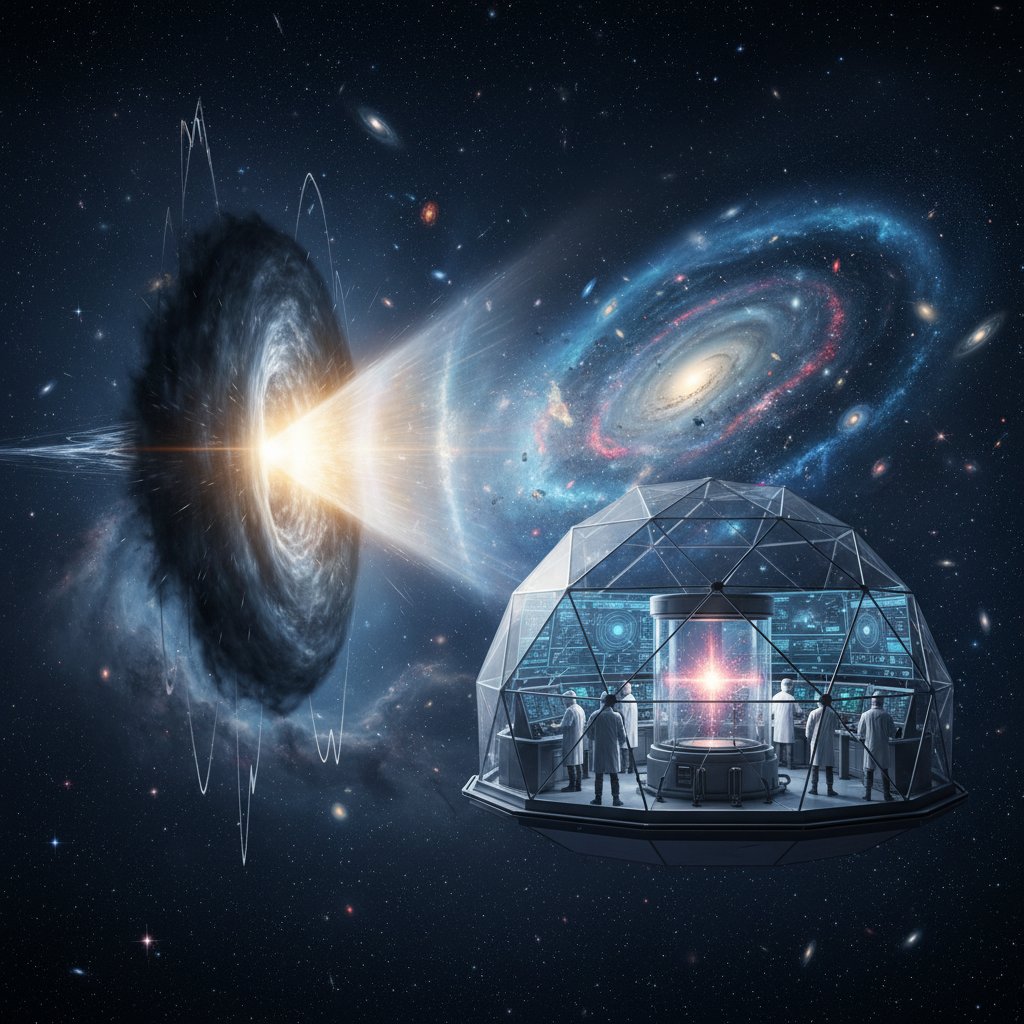
This idea—dubbed “black hole to white hole transition”—offers an elegant narrative: a black hole in a parent universe collapses, undergoes a quantum bounce, and then erupts as a white hole, blowing out all its accumulated matter and energy into a new expanding region of space—our universe.
A Cosmic Birth from a White Hole?
If the Big Bang was a white hole, it would solve several puzzles at once. First, no initial singularity: the white hole emerges from a finite, quantum-sized object. Second, it naturally explains why the universe began with an explosion—white holes are defined by outflows. Third, it might account for the universe’s low entropy at the Big Bang. A black hole’s interior is high-entropy; after a bounce, the white hole would eject low-entropy material, matching the observed smoothness of the early cosmos.
But can we test this? Directly observing a white hole is nearly impossible. They are predicted to be extremely rare and tiny—Planck-scale objects (10-35 meters) that would evaporate almost instantly in our universe. However, if one of these white holes survived from the Big Bang to today, it might produce a distinct signal: a brief, powerful burst of gamma rays as it finally decays.
“We’ve searched for such bursts in data from Fermi and other gamma-ray telescopes,” says Dr. James Faulkner, an astrophysicist at the University of Cambridge who studies exotic transients. “So far, no candidate events match the predicted white hole signature. But the search is just beginning—next-generation observatories like SVOM and the proposed TIGER mission could improve sensitivity by orders of magnitude.”
Another test involves gravitational waves. A black hole-to-white hole transition would generate a distinct “bounce” signal—a chirp followed by a long, low-frequency ring. “It’s a prediction we can actually check with LISA once it launches in the 2030s,” adds Faulkner.
Challenges and Next Steps
Despite its appeal, the white hole hypothesis faces serious hurdles. The biggest is that white holes, unless stabilized by quantum gravity, are inherently unstable: any incoming particle would trigger an immediate explosion. In our universe, even the cosmic microwave background photons would destroy a white hole in microseconds. Proponents argue that quantum gravity effects might suppress this instability, but the mathematics is still being worked out.
Moreover, the theory remains highly speculative—a “what if” more than a “how.” Critics point out that invoking a previous universe simply pushes the origin question back one step. “It’s a classic cosmologist’s trick: solve the beginning problem by assuming there was no beginning,” says Dr. Priya Singh, a philosopher of physics at the University of Oxford. “But if the white hole itself requires a quantum bounce, we still need to explain why that bounce happened—why the laws of physics allow it.”
Nevertheless, the white hole concept has reinvigorated debate about the Big Bang’s origins. It offers a concrete alternative to inflation or a quantum vacuum fluctuation, and it connects two seemingly unrelated objects—black holes and the universe’s birth. If even a fraction of these ideas prove correct, we may one day look at the cosmic microwave background and see not the afterglow of a beginning, but the echo of a previous universe’s death.
“We live in an era where we can actually test these ideas,” says Dr. Voss. “Twenty years ago, white holes were a mathematical curiosity. Today, they are a laboratory for quantum gravity. The next decade—with LISA, with improved gamma-ray surveys, with better numerical simulations—will tell us whether this is just a beautiful story or a real description of our cosmic genesis.”
The Big Bang may still hold secrets, but white holes are pointing the way toward a plausible, testable narrative. Whether they survive scrutiny or not, they remind us that the universe’s greatest mysteries often demand the boldest ideas.