








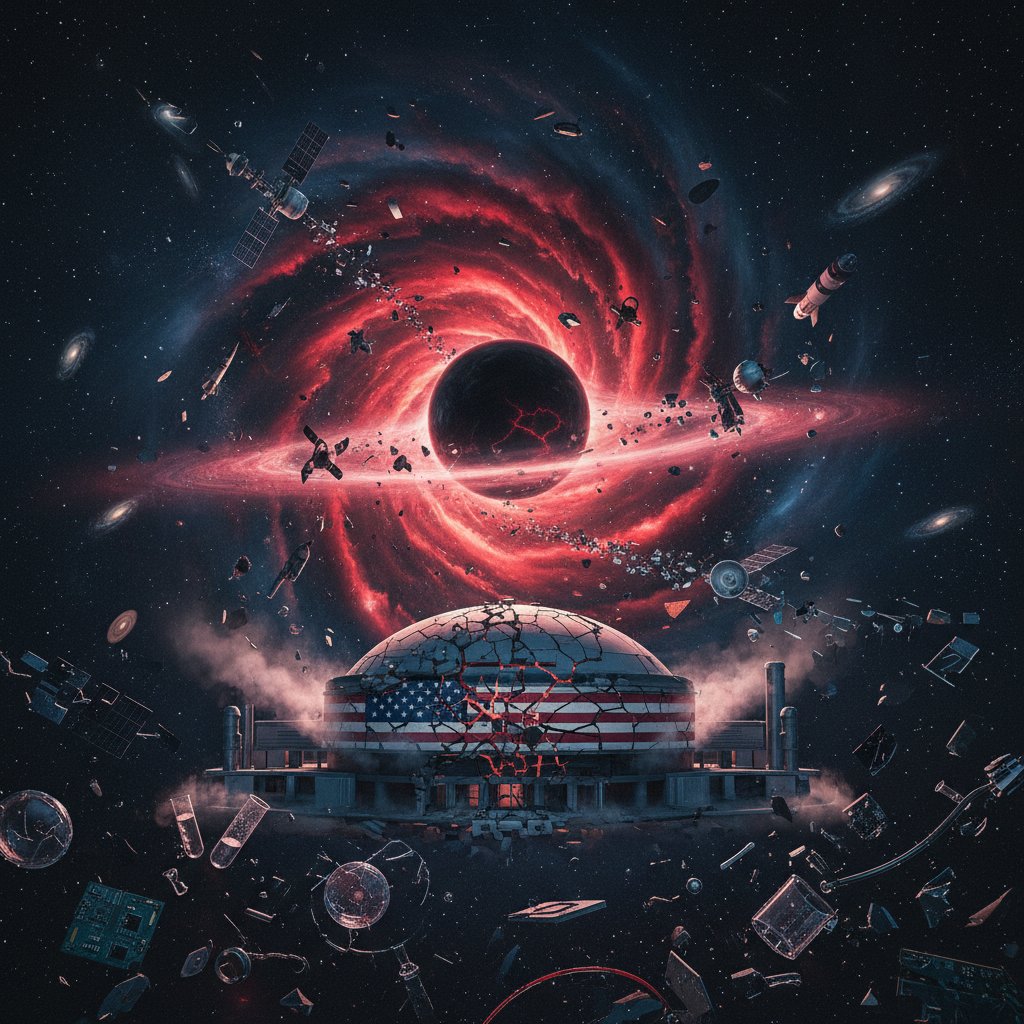
Imagine a world where NASA’s James Webb Space Telescope is mothballed, where the National Science Foundation’s funding for basic research is slashed by a third, and where the next generation of American scientists must look abroad for opportunity. That dystopian scenario moved one step closer to reality last week when a coalition of lawmakers introduced a bill that, if passed, would dismantle decades of scientific progress in the United States. The proposed legislation—dubbed by critics as the ‘Let’s Destroy American Science Act’—would cut funding for the NSF by 30%, eliminate NASA’s Earth science division, and reduce NIH grants by 25%. The message from Capitol Hill is clear: American science is under siege.
The bill’s sponsors argue that the cuts are necessary to reduce the federal deficit, pointing to a $1.5 trillion national debt. But scientists and policymakers warn that the real cost would be far greater—a permanent loss of U.S. leadership in innovation, medicine, and space exploration. The question is not whether the cuts will happen, but whether the public will wake up in time to stop them.
A Blueprint for Retreat
The proposed cuts are sweeping. The NSF, which funds roughly 25% of all federally supported basic research at U.S. colleges and universities, would see its budget reduced from $9.9 billion to just under $7 billion. That would mean tens of thousands of research projects eliminated, from quantum computing to climate modeling. NASA’s science portfolio would be slashed by $2.3 billion, effectively ending missions to study the sun, monitor sea-level rise, and search for exoplanets. The NIH, the world’s largest public funder of biomedical research, would lose $11 billion, forcing a halt to clinical trials for cancer, Alzheimer’s, and rare genetic diseases.
Dr. Maria Chen, director of the Center for Science Policy at MIT, doesn’t mince words. “This is not austerity—it’s a self-inflicted wound,” she says. “Every dollar we invest in science returns multiple times over in economic growth, public health, and national security. These cuts would set us back decades and hand the mantle of scientific leadership to China and Europe.” Chen points to a 2024 report from the National Academies that found that for every $1 of NSF funding, the private sector leverages $8 in additional R&D. The proposed cuts, she warns, would create a ripple effect across the entire economy.
What the Cuts Would Mean for You
For the average American, the consequences are not abstract. Fewer NSF grants mean fewer university researchers training the next generation of engineers and data scientists. That translates to a less competitive workforce. NASA’s Earth science division, which provides critical data on hurricanes, droughts, and wildfires, would be gutted—making it harder to predict and respond to natural disasters. And NIH cuts would delay breakthroughs in treatments for diabetes, heart disease, and mental health disorders.
Dr. James Okafor, former director of the National Institutes of Health, sees the bill as a betrayal of the nation’s covenant with its scientists. “We are telling our best and brightest: ‘We don’t value your work. Go elsewhere,'” he says. “And they will. I’m already seeing a shift: top postdocs are rejecting U.S. offers and heading to labs in Germany, Singapore, and China. This bill will accelerate that brain drain.” Okafor notes that the U.S. has long attracted the world’s talent—one-third of NIH-funded researchers are foreign-born. If those scientists leave, they may never return.
“We are telling our best and brightest: ‘We don’t value your work. Go elsewhere.’ And they will.”
— Dr. James Okafor, former NIH Director
History Repeating Itself?
The United States has faced similar crossroads before. In the late 1960s, the Vietnam War and social unrest led to cuts in science funding that stalled progress for nearly a decade. It took the Soviet Union’s launch of Sputnik in 1957 to spur a massive reinvestment in science education and research—the golden era of U.S. innovation. But this time, the threat is not an external competitor; it’s internal indifference. A 2023 Pew survey found that only 38% of Americans trust science leaders to act in the public’s interest. The erosion of trust has made science an easy target for budget hawks.
Yet history also offers a lesson. When the U.S. did invest—from the Human Genome Project to the Apollo program—the returns were enormous. The internet, GPS, MRIs, and even the mRNA vaccine technology that made COVID-19 shots possible all trace back to federally funded basic research. “Killing scientific research is like defunding the foundation of a house because the roof isn’t leaking,” says Dr. Chen. “You might save a few dollars now, but the whole structure will eventually collapse.”
Fighting for the Future
The bill is not yet law. It faces fierce opposition from Democrats, a handful of Republicans from science-heavy districts, and a coalition of universities, tech companies, and medical associations. The American Physical Society has launched an advocacy campaign, urging its 50,000 members to contact their representatives. Meanwhile, the White House has threatened a veto, calling the cuts “catastrophic.” The fight will be decided in the coming weeks—a battle between short-term fiscal conservatism and long-term prosperity.
But the real battle is for the hearts and minds of voters. Dr. Okafor believes the public can be swayed. “When people realize that a cure for their child’s disease or a better weather warning system depends on this funding, they will act,” he says. “Science isn’t a luxury—it’s a lifeline.” He urges citizens to attend town halls, write op-eds, and vote with science in mind.
Look ahead: The next decade will determine whether the United States remains the world’s innovation engine or cedes its position to others. The choice is stark. As Dr. Chen puts it, “We can either invest in the future or destroy it. There is no middle ground.” For now, the fate of American science lies not in the halls of Congress but in the hands of a nation that must remember what made it great.